Skitter in the Big City
Kaitlyn Matychuk
See it On Campus: Level 2
Enter through the main entrance on the southwest side of the building, then head down the hall to the right. Located in front of the library/reading room.
Visitor Info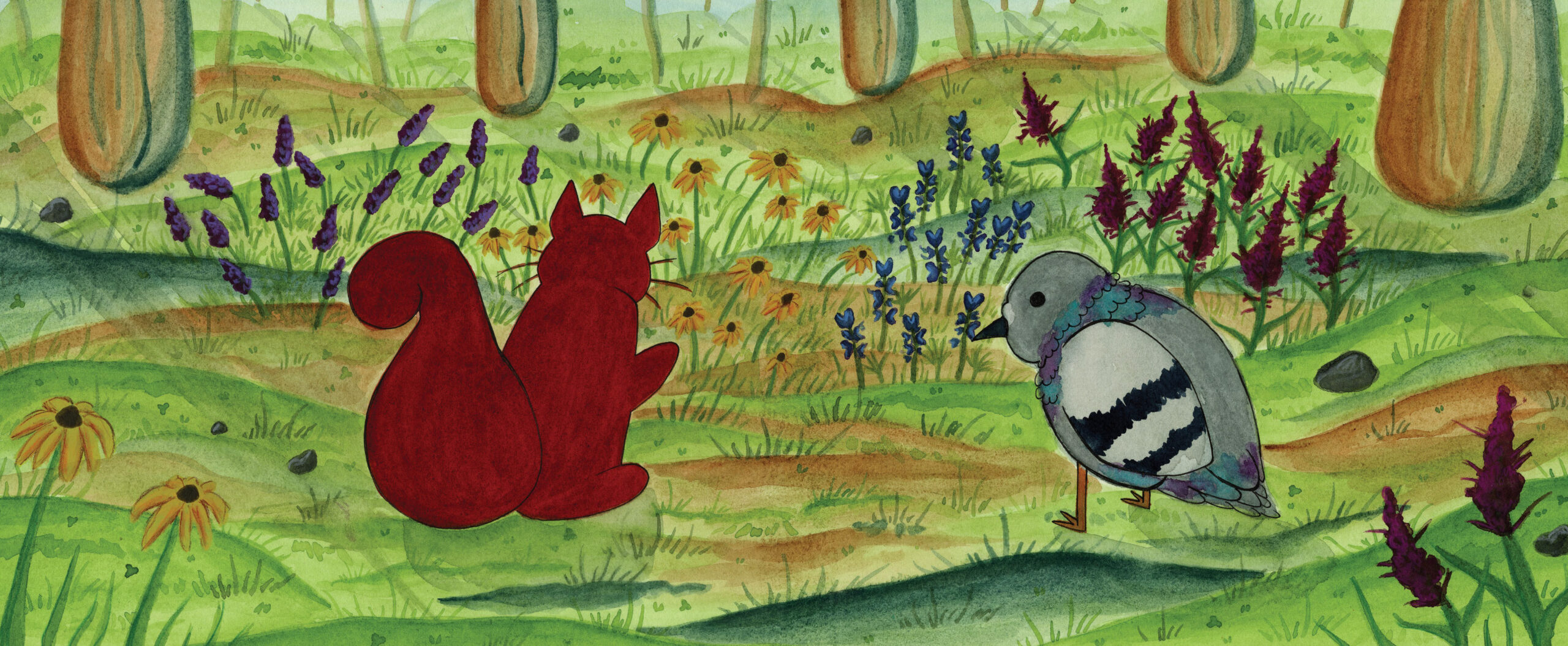
Skitter in the Big City
(For best viewing experience, please rotate your phone to the side. All images on this page may be clicked on to view in full screen.)
Skitter in the Big City is a picture book aimed towards children in grades K-3 that focuses on exploring the integration of nature in urban spaces, and how humans can support the environment. Skitter joins Pogo in the big city and together they learn of new ways to help the environment.
This book is a sequel to Skitter and the Old-Growth Forest, a children’s picture book that I created last semester. I was inspired to create a picture book because of my interest in the environment and the students that I teach at the Taekwondo school where I work.
Over the past year I’ve discovered an interest in creating illustrations for children’s picture books. I wanted to challenge myself this semester to create a picture book that was near ready to be published.
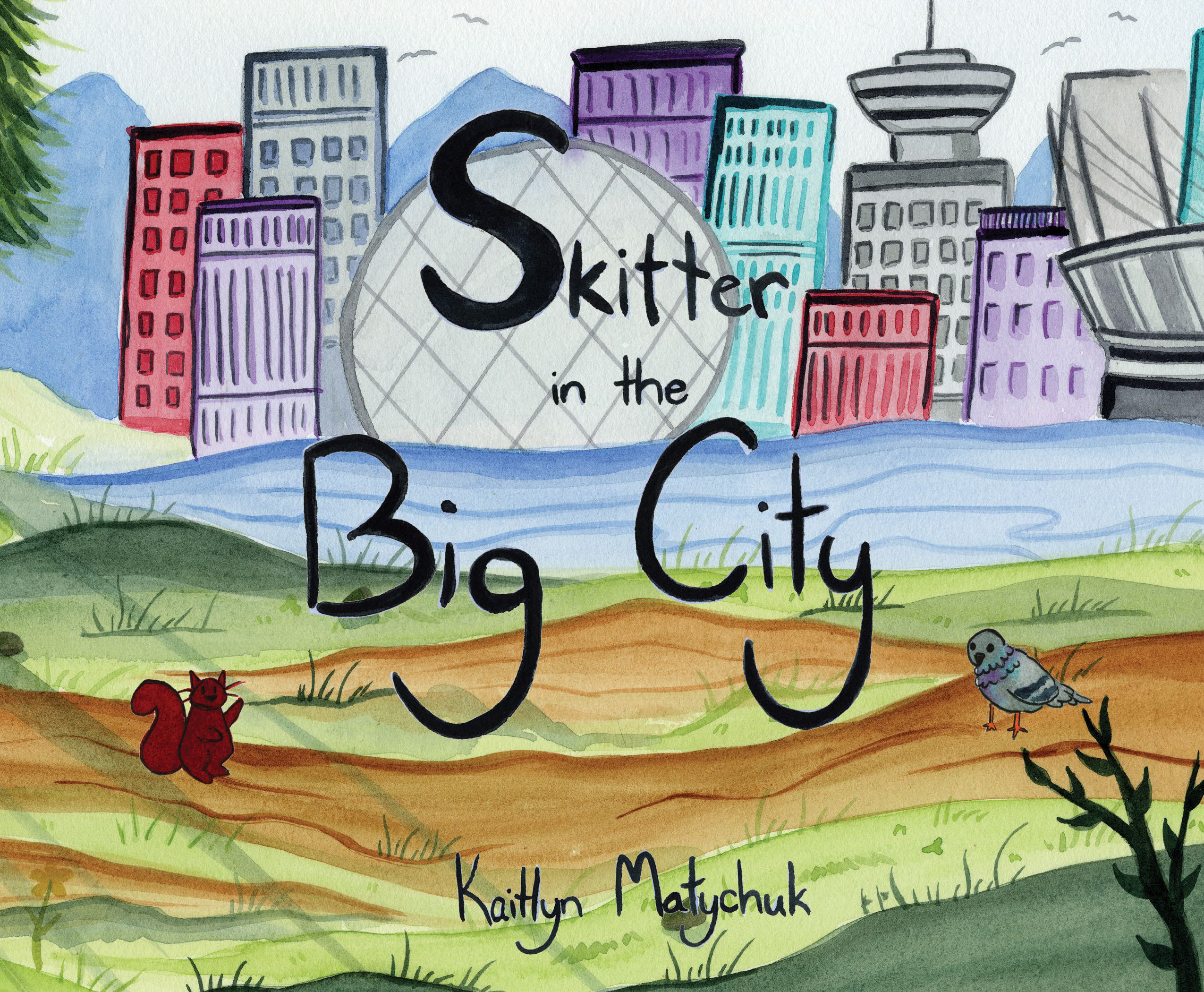
Skitter in the Big City follows Skitter the squirrel as he goes from the forest into the city. Together with Pogo the pigeon, children can learn about ways to support the environment. It’s targeted towards children that are reading the books either with parents or at school, and can inspire activities that the children can participate in.
Book Spreads
Illustrated, written, and designed by Kaitlyn Matychuk
All of the artwork for Skitter in the Big City was painted traditionally using watercolour on paper. The images were then scanned all the text was added digitally.
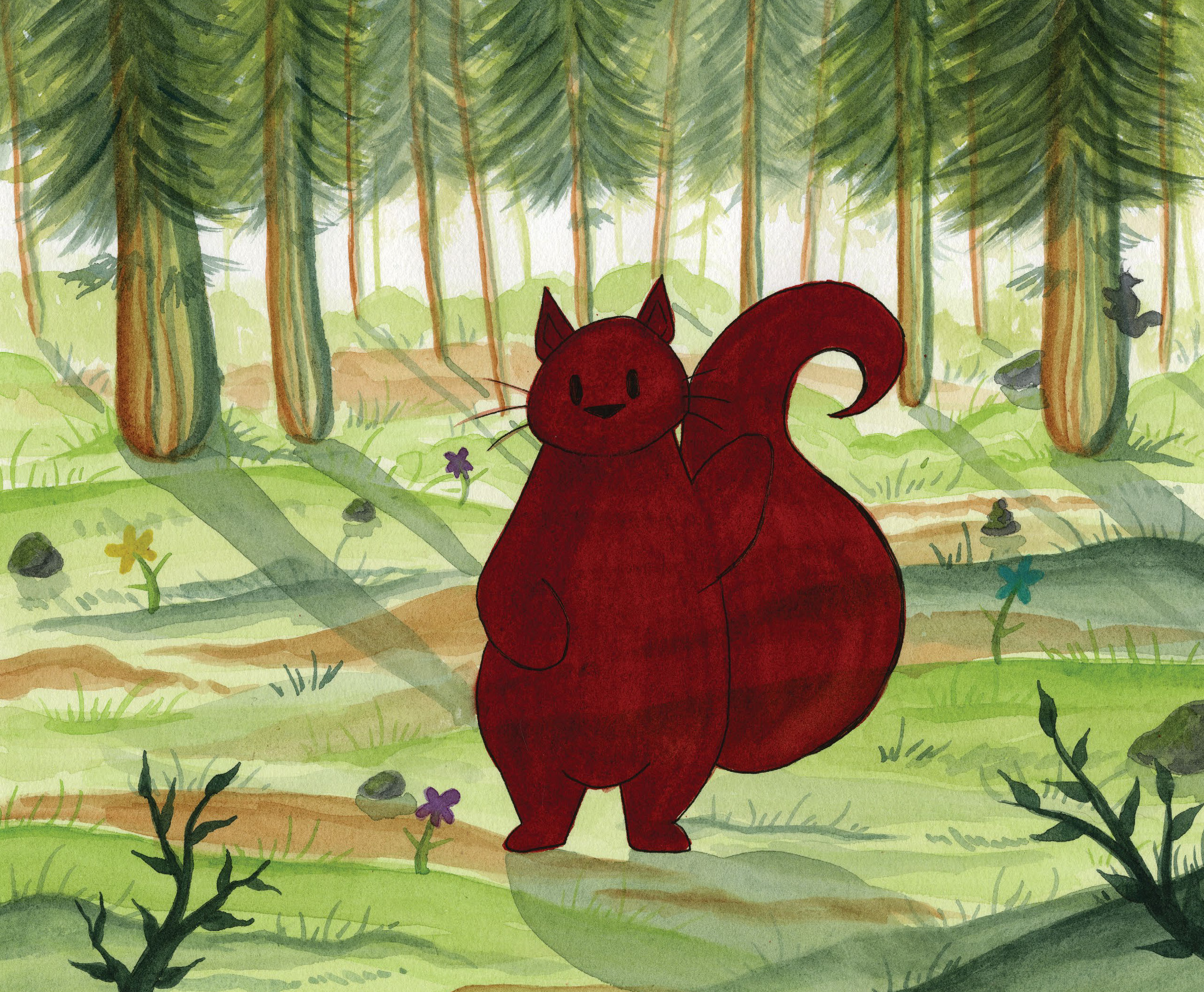
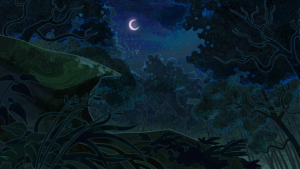
There was once an Old-Growth Forest. The forest was vast and full of different types of wildlife. There were trees and flowers, rocks and rivers, and lots and lots of animals.
One of the animals that lived in this forest was a little red squirrel named Skitter!
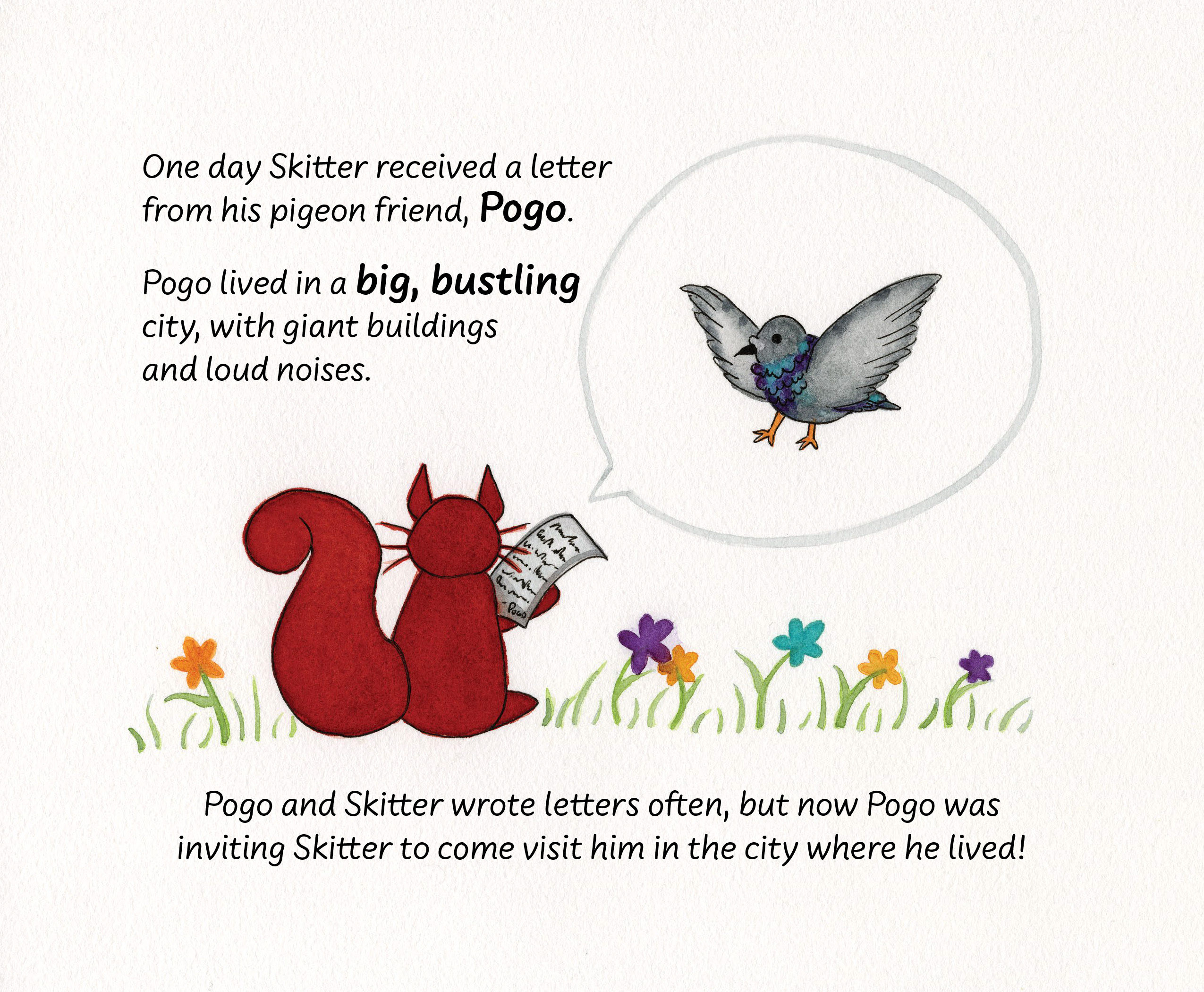
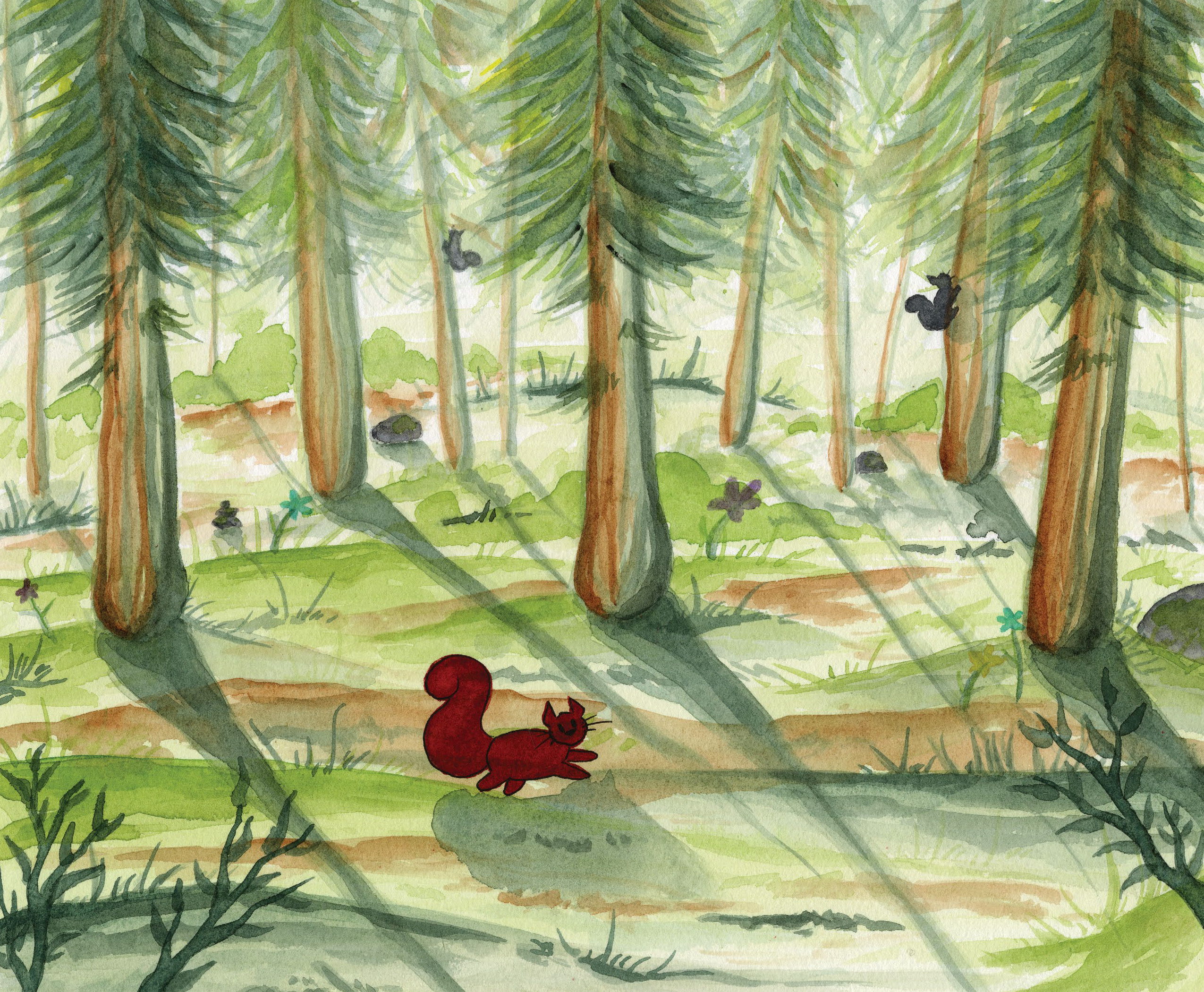
One day Skitter received a letter from his pigeon friend, Pogo. Pogo lived in a big, bustling city, with giant buildings and loud noises.
Pogo and Skitter wrote letters often, but now Pogo was inviting Skitter to come visit him in the city where he lived!
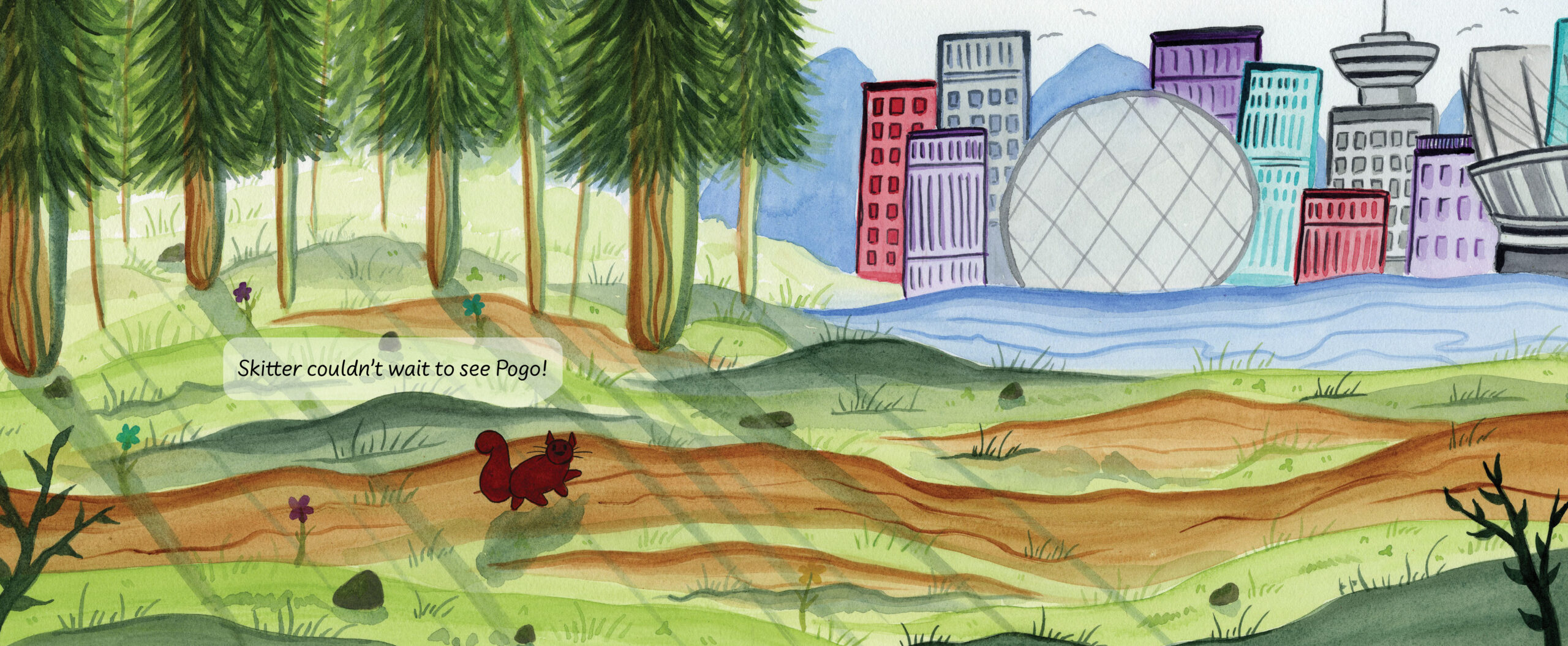
Skitter couldn’t wait to see Pogo!
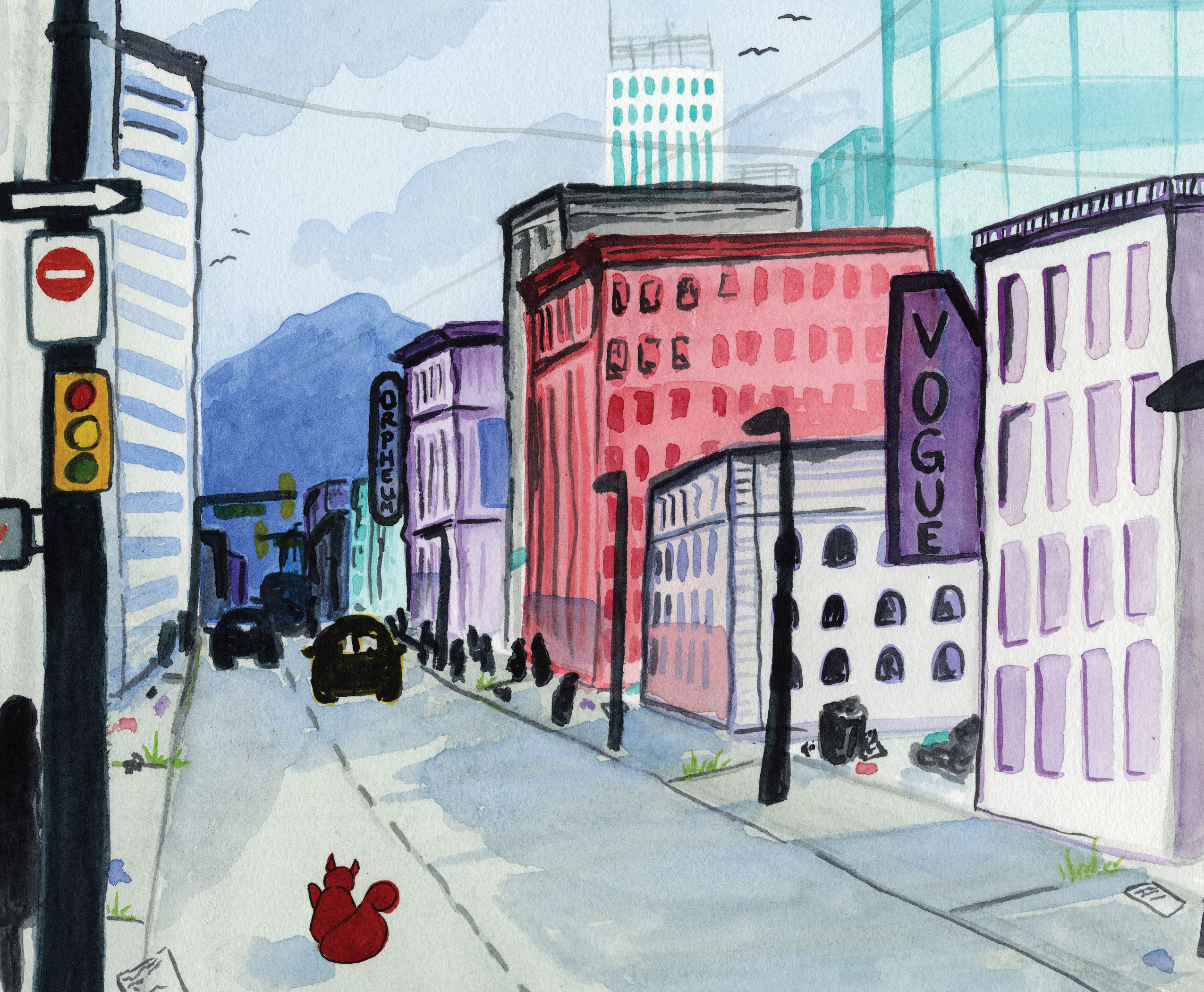
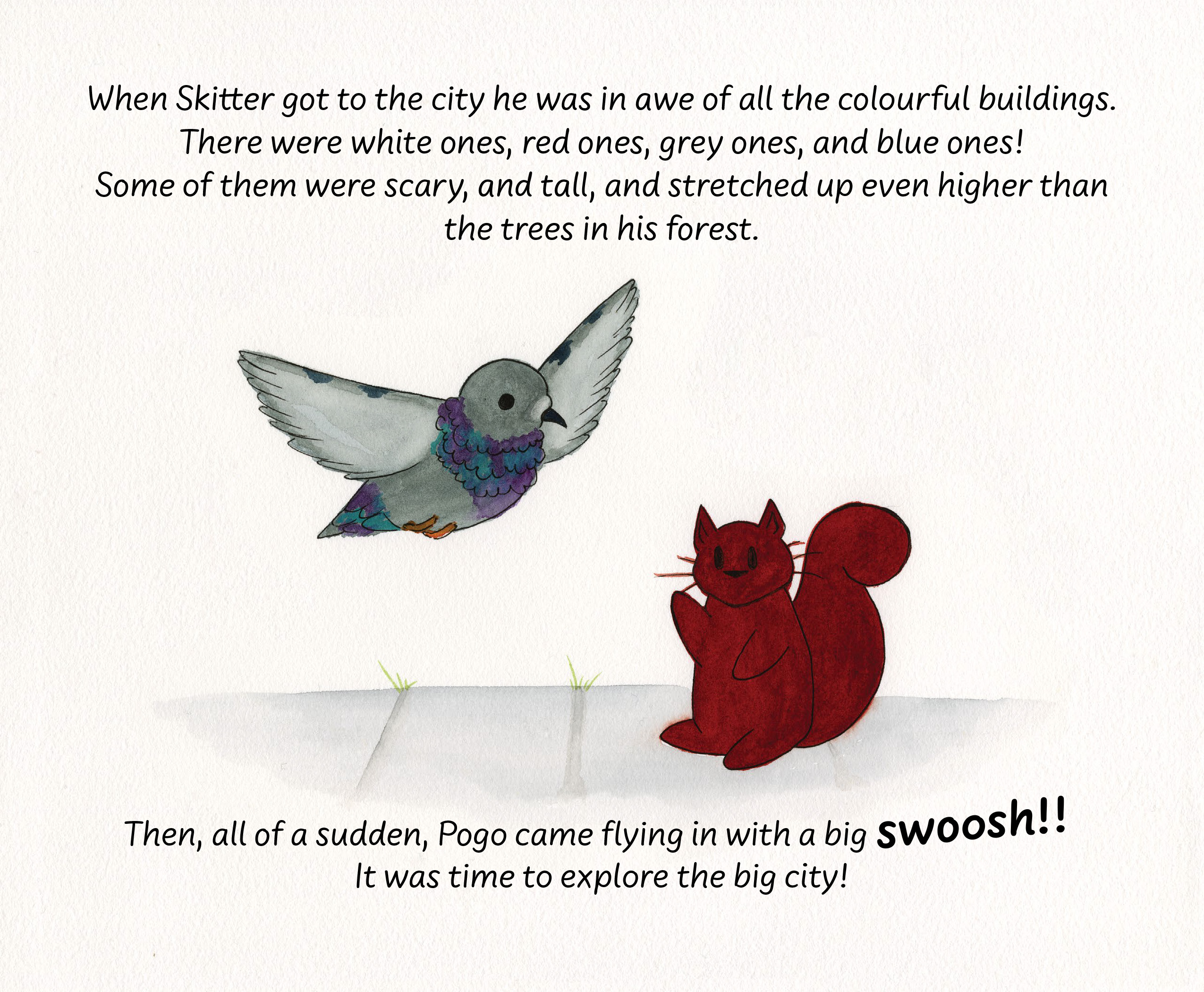
When Skitter got to the city he was in awe of all the colourful buildings. There were white ones, red ones, grey ones, and blue ones! Some of them were scary, and tall, and stretched up even higher than the trees in his forest.
Then, all of a sudden, Pogo came flying in with a big swoosh. It was time to explore the big city!
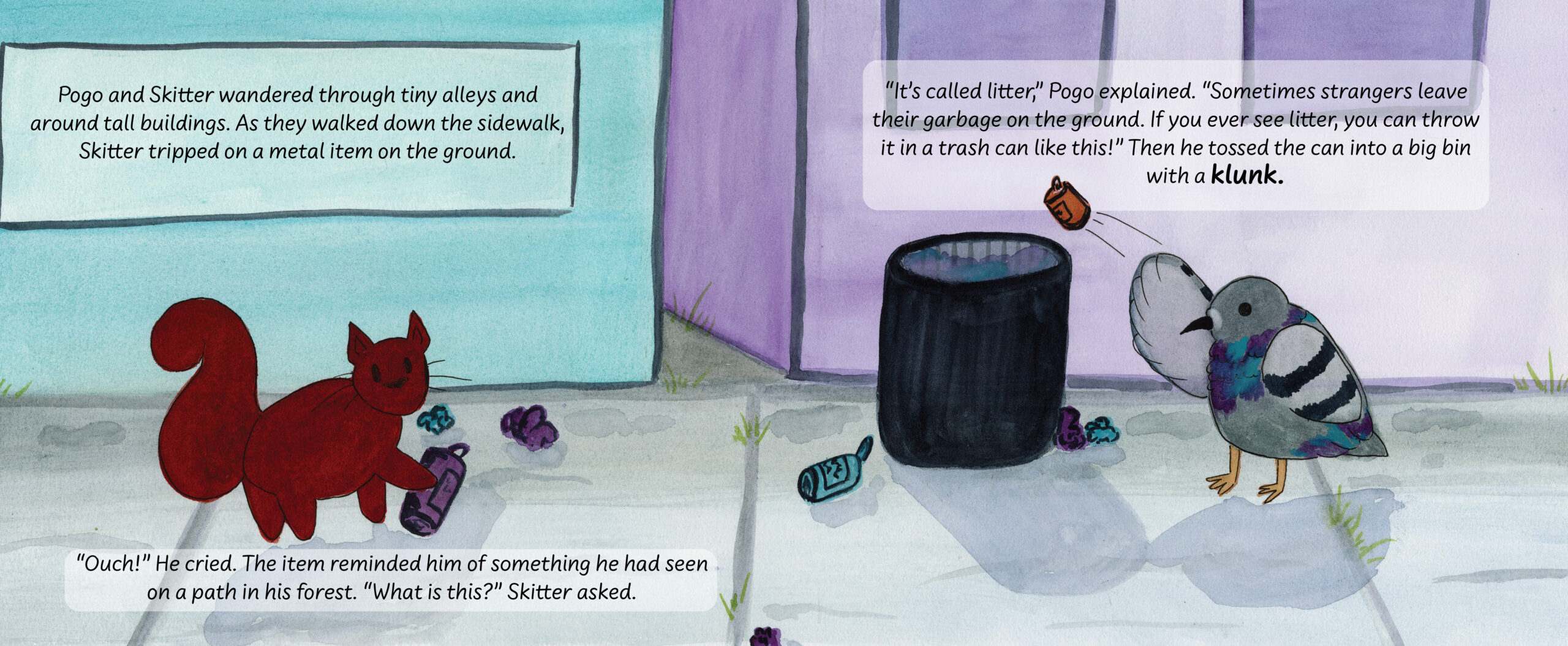
Pogo and Skitter wandered through tiny alleys and around tall buildings. As they walked down the sidewalk, Skitter tripped on a metal item on the ground.
“Ouch!” He cried. The item reminded him of something he had seen on a path in his forest. “What is this?” Skitter asked.
“It’s called litter,” Pogo explained. “Sometimes strangers leave their garbage on the ground. If you ever see litter, you can throw it in a trash can like this!” Then he tossed the can into a big bin with a klunk.
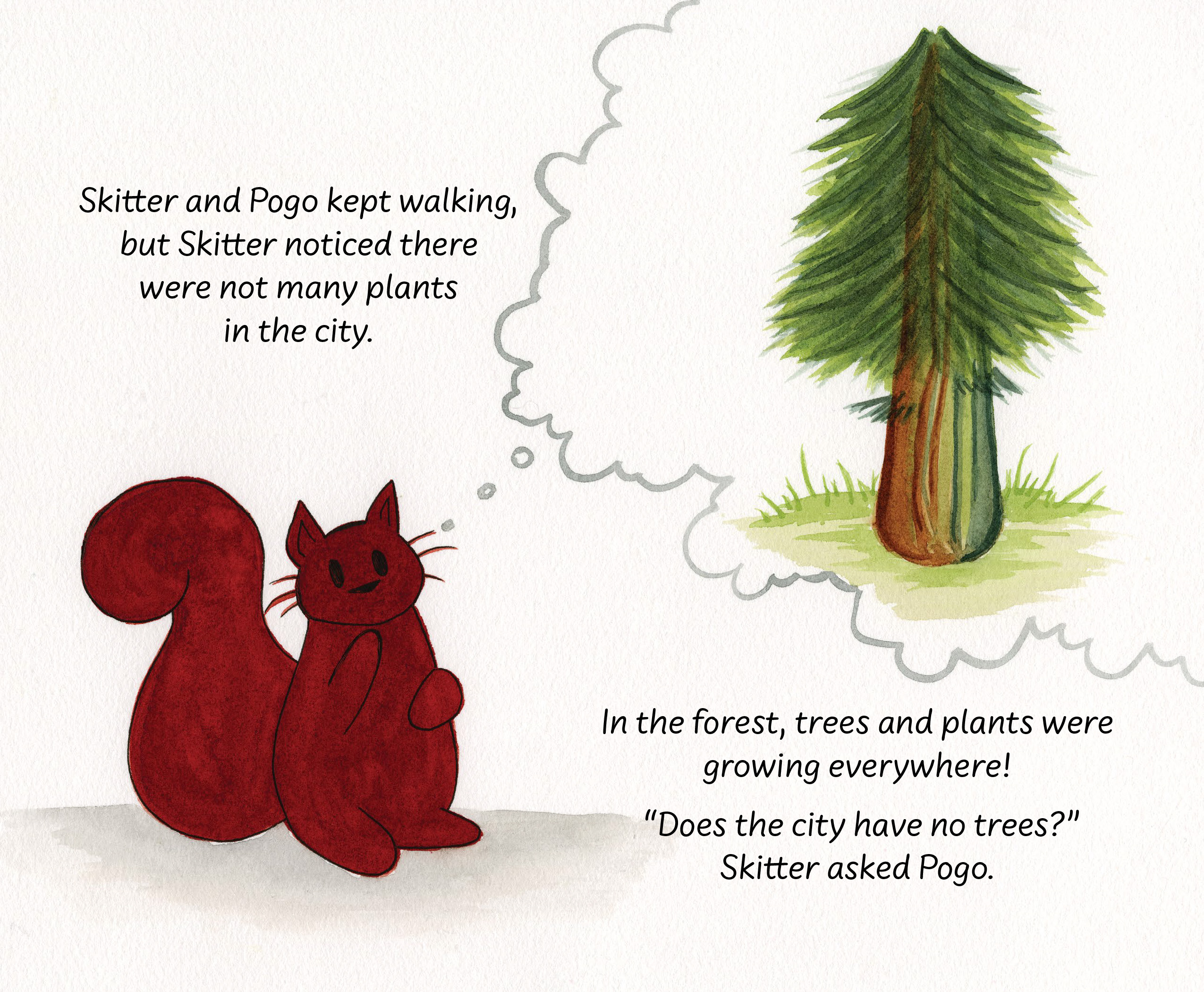
Skitter and Pogo kept walking, but Skitter noticed there were not many plants in the city.
In the forest, trees and plants were growing everywhere! “Does the city have no trees?” Skitter asked Pogo.
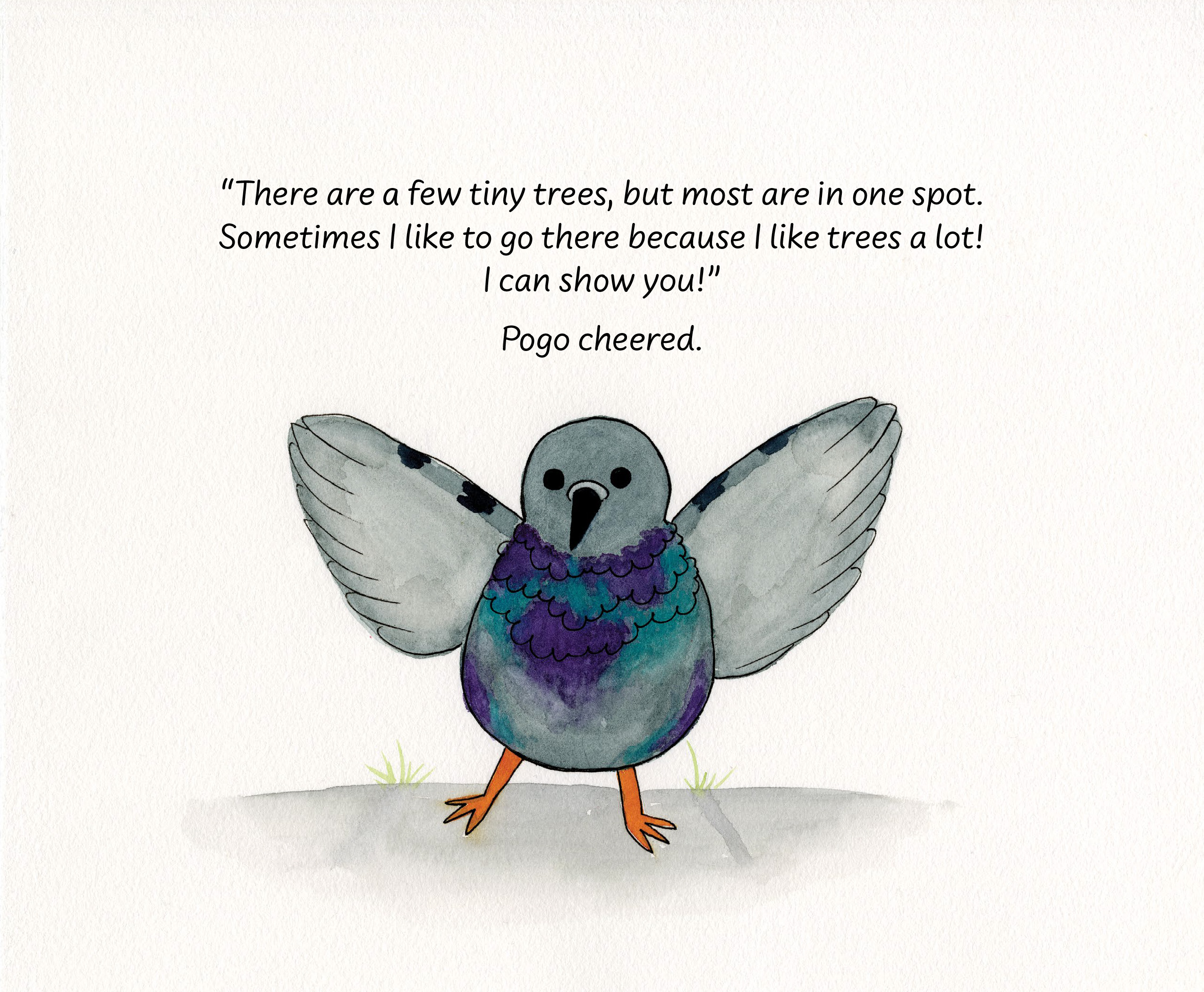
“There are a few tiny trees, but most are in one spot! Sometimes I like to go there because I like trees a lot! I can show you!” Pogo cheered.
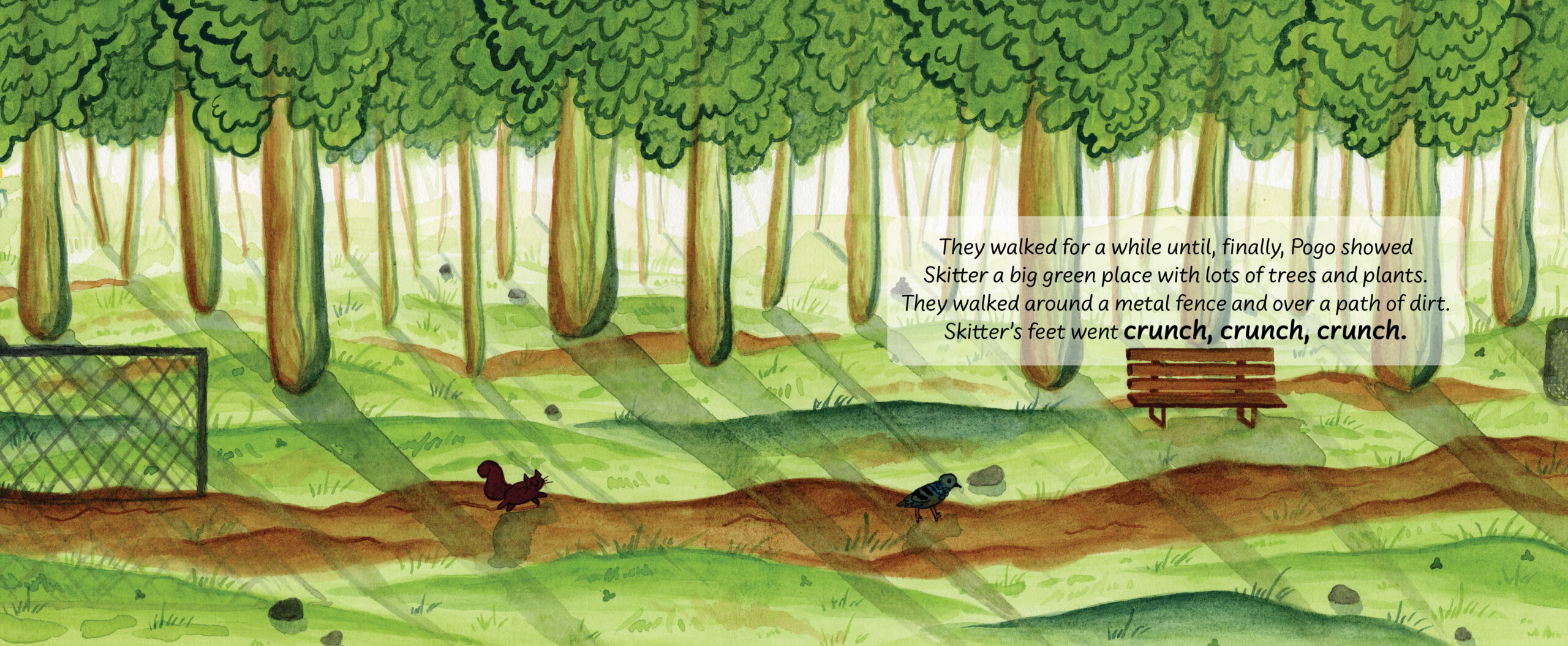
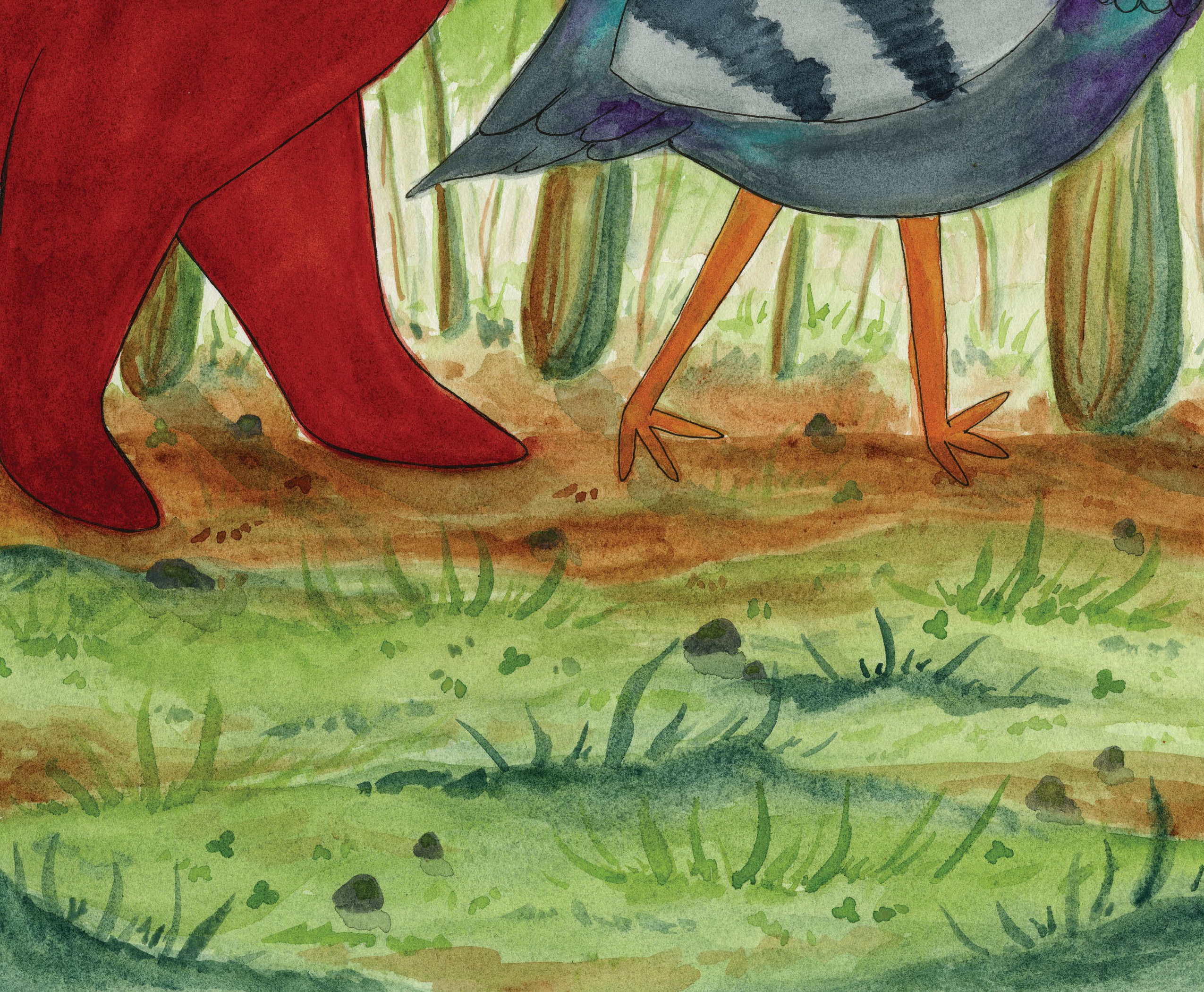
They walked for a while until, finally, Pogo showed Skitter a big green place with lots of trees and plants. They walked around a metal fence and over a path of dirt. Skitter’s feet went crunch, crunch, crunch.
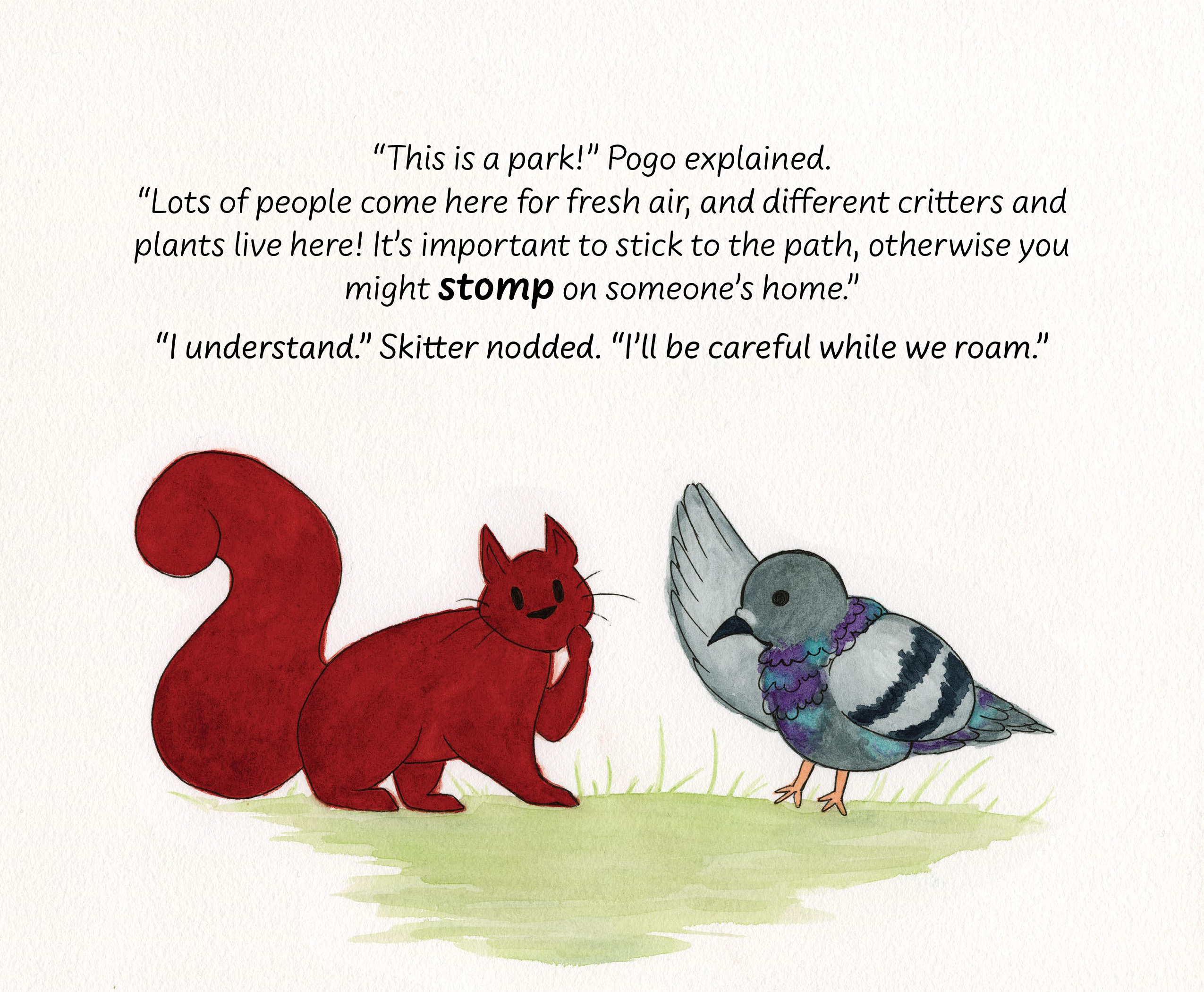
“This is a park!” Pogo explained. “Lots of people come here for fresh air, and different critters and plants live here! It’s important to stick to the path, otherwise you might stomp on someone’s home.”
“I understand.” Skitter nodded. “I’ll be careful while we roam.”
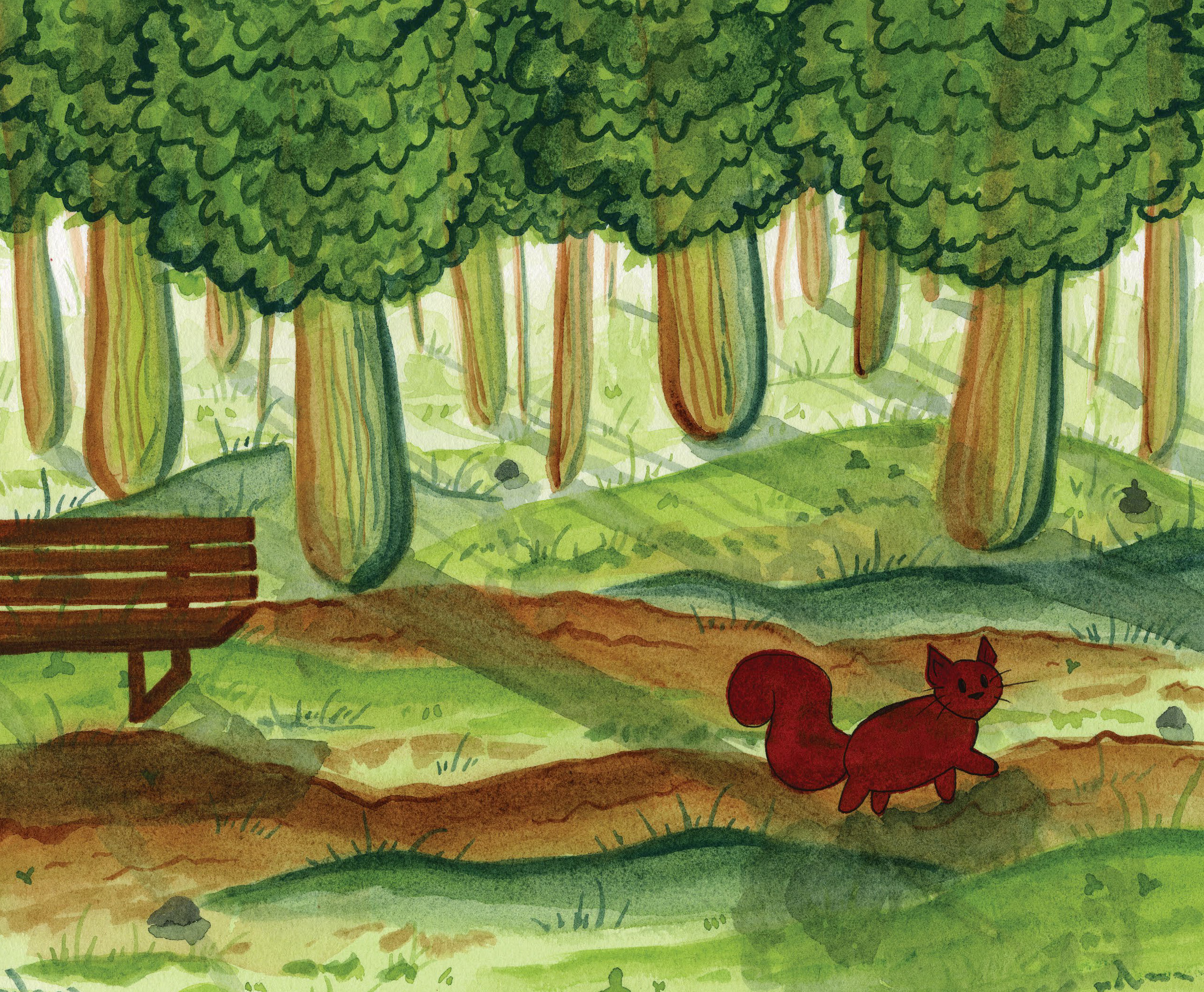
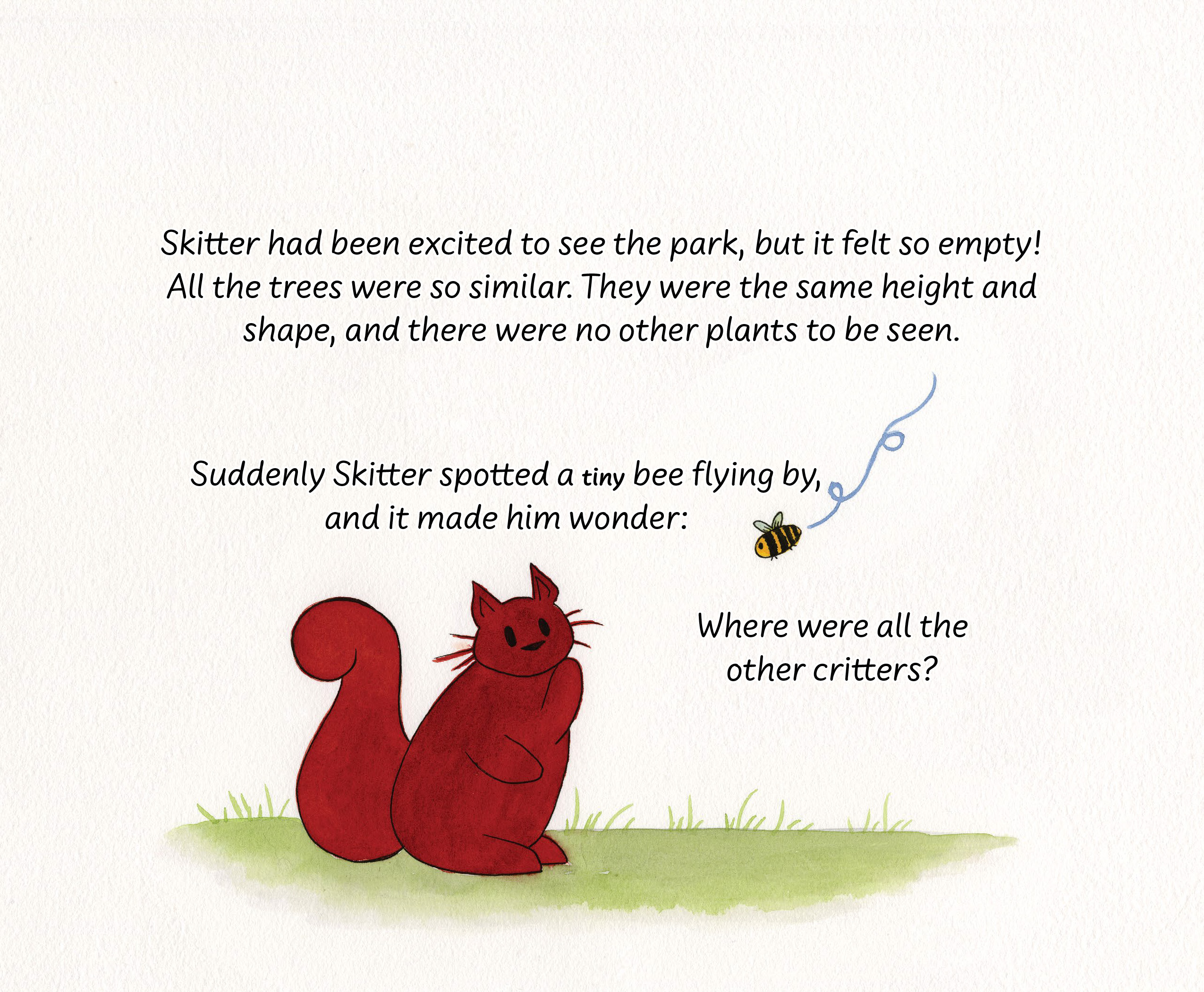
Skitter had been excited to see the park, but it felt so empty! All the trees were so similar. They were the same height and shape, and there were no other plants to be seen.
Suddenly Skitter spotted a tiny bee flying by, and it made him wonder: Where were all the other critters?
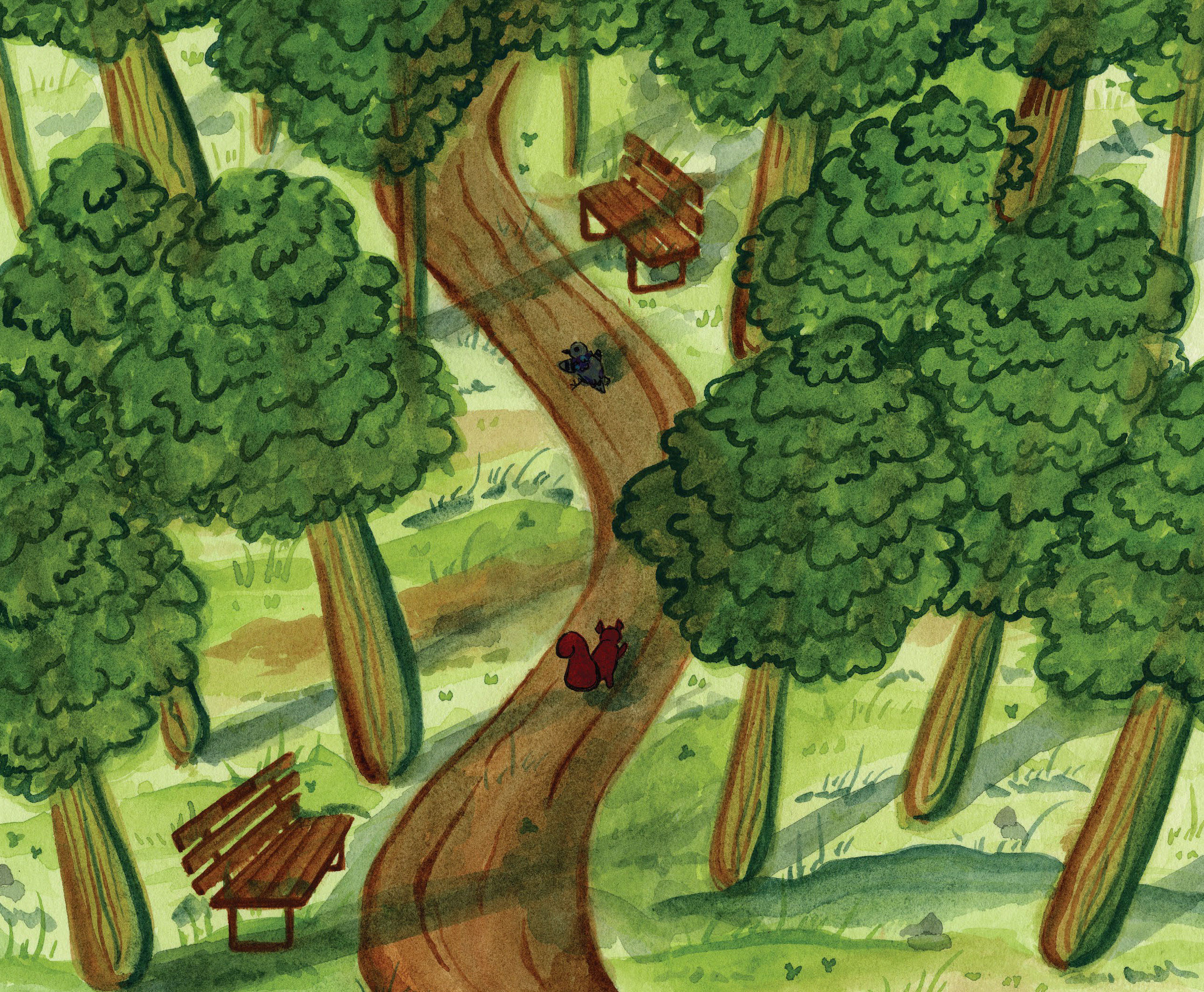
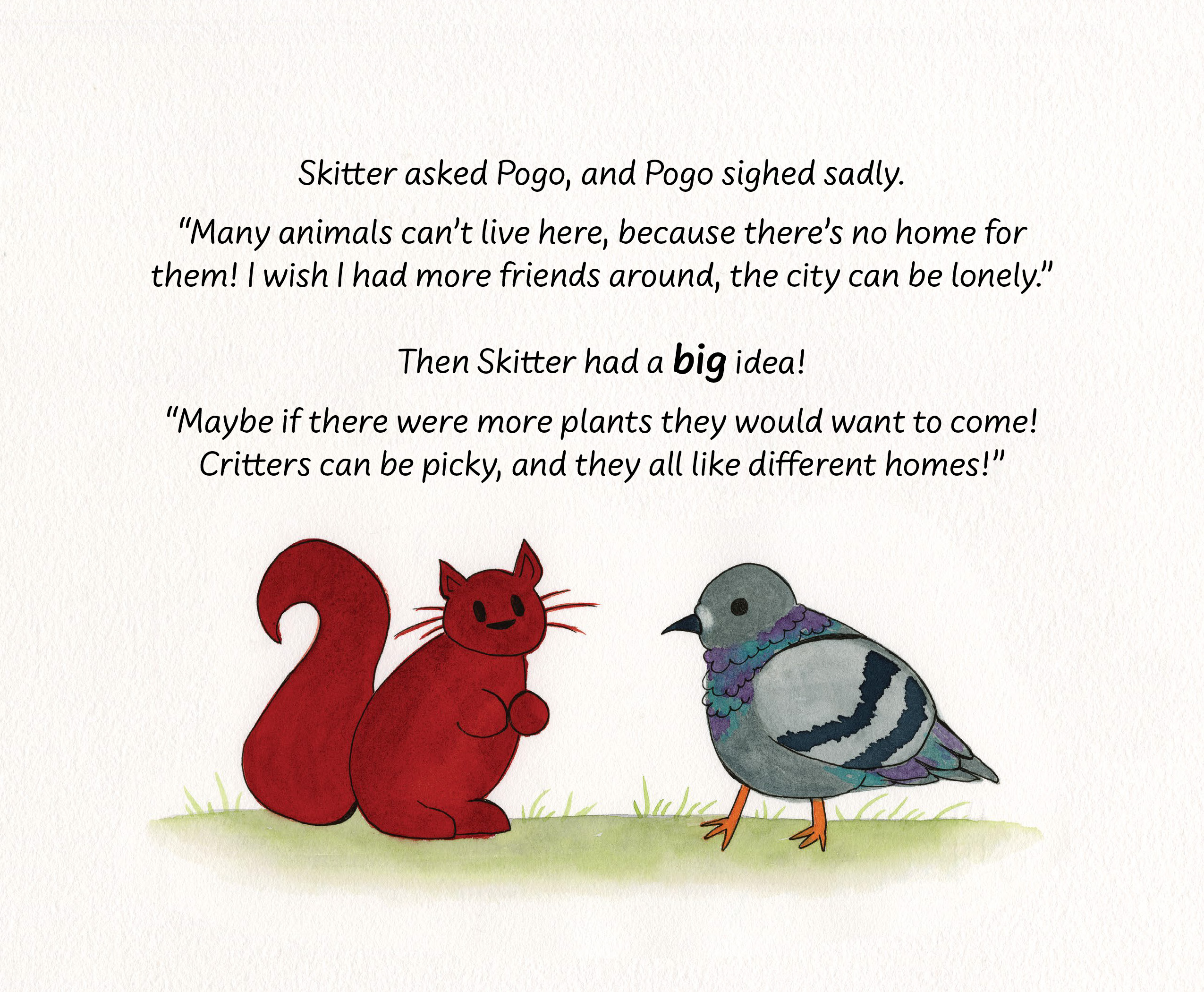
Skitter asked Pogo, and Pogo sighed sadly. “Many animals can’t live here, because there’s no home for them! I wish I had more friends around, the city can be lonely.”
Then Skitter had a big idea! “Maybe if there were more plants they would want to come! Critters can be picky, and they all like different homes!“
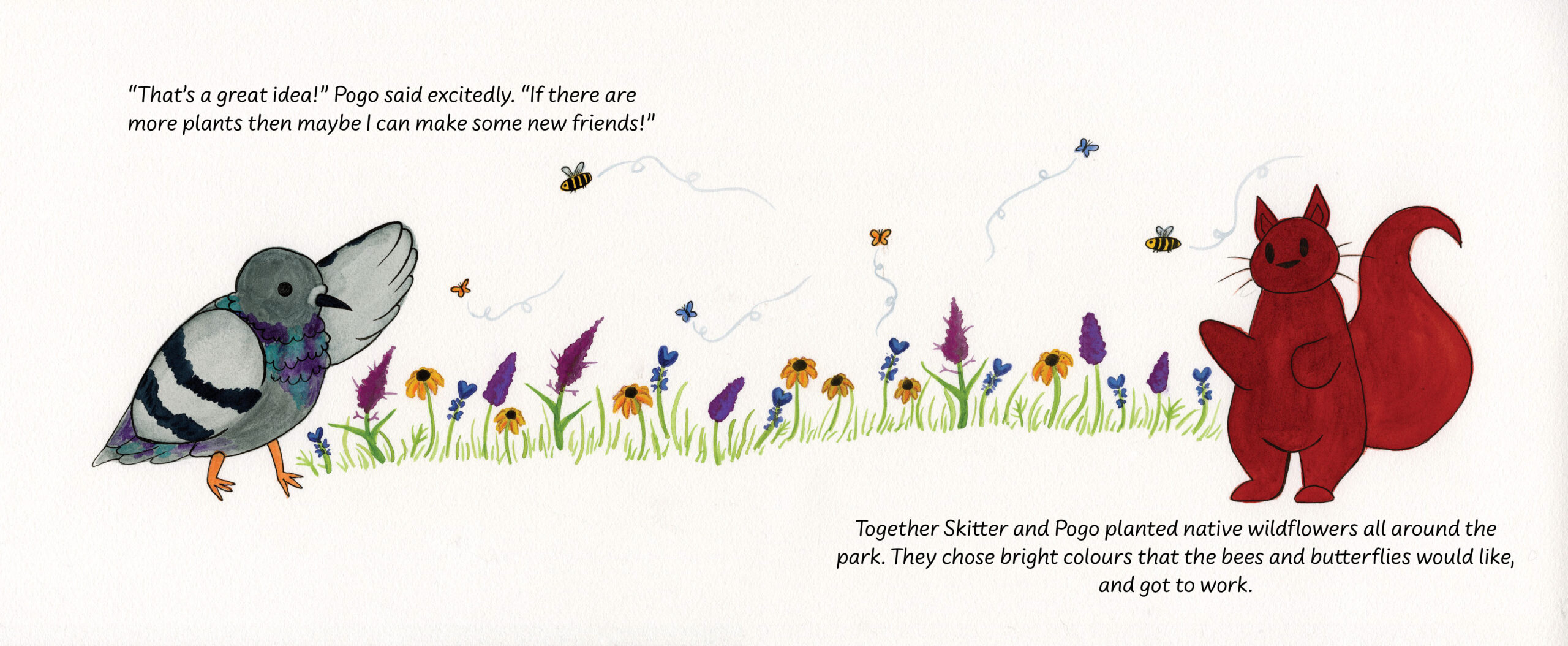
“That’s a great idea!” Pogo said excitedly. “If there are more plants then maybe I can make some new friends!”
Together Skitter and Pogo planted native wildflowers all around the park. They chose bright colours that the bees and butterflies would like, and got to work.
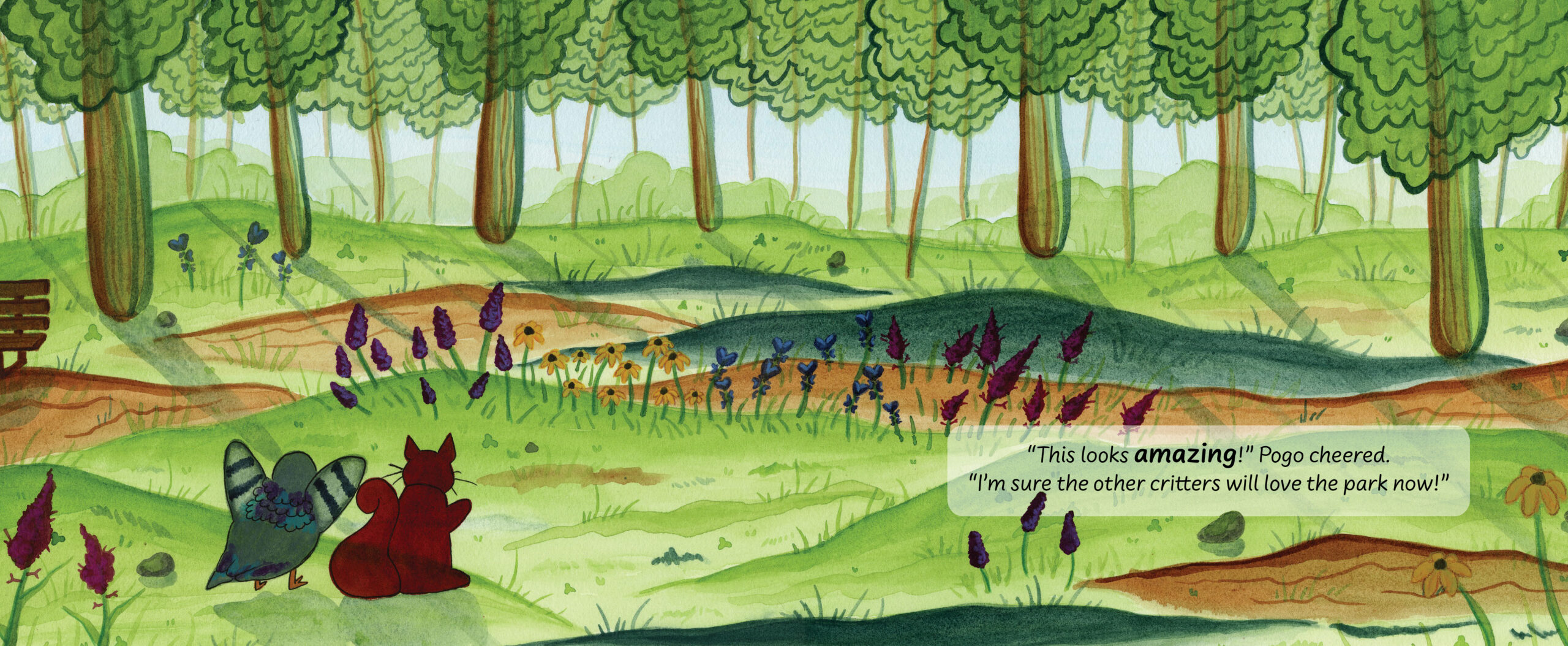
“This looks amazing!” Pogo cheered. “I’m sure the other critters will love the park now!“
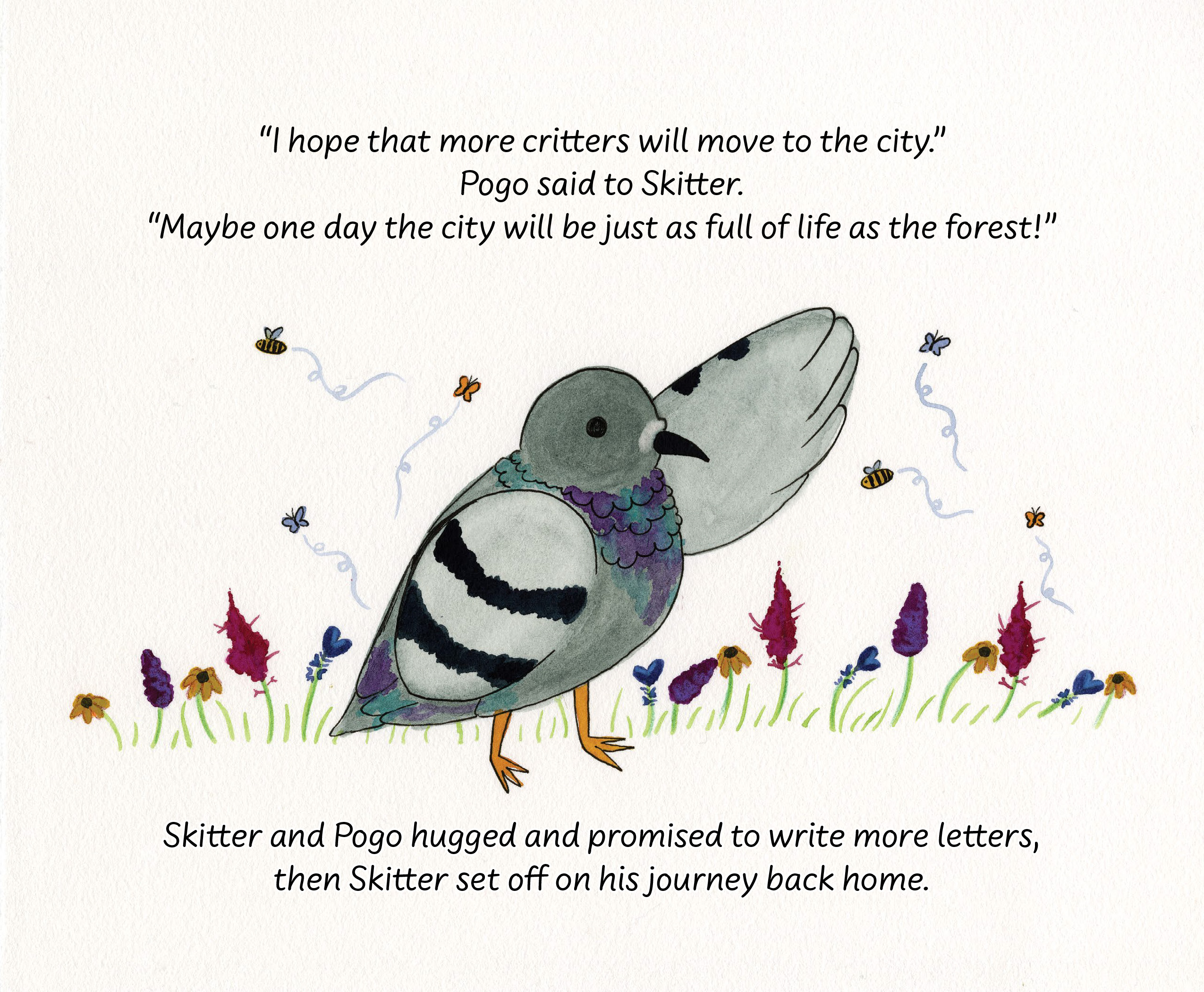
“I hope that more critters will move to the city,” Pogo said to Skitter. “Maybe one day the city will be just as full of life as the forest!”
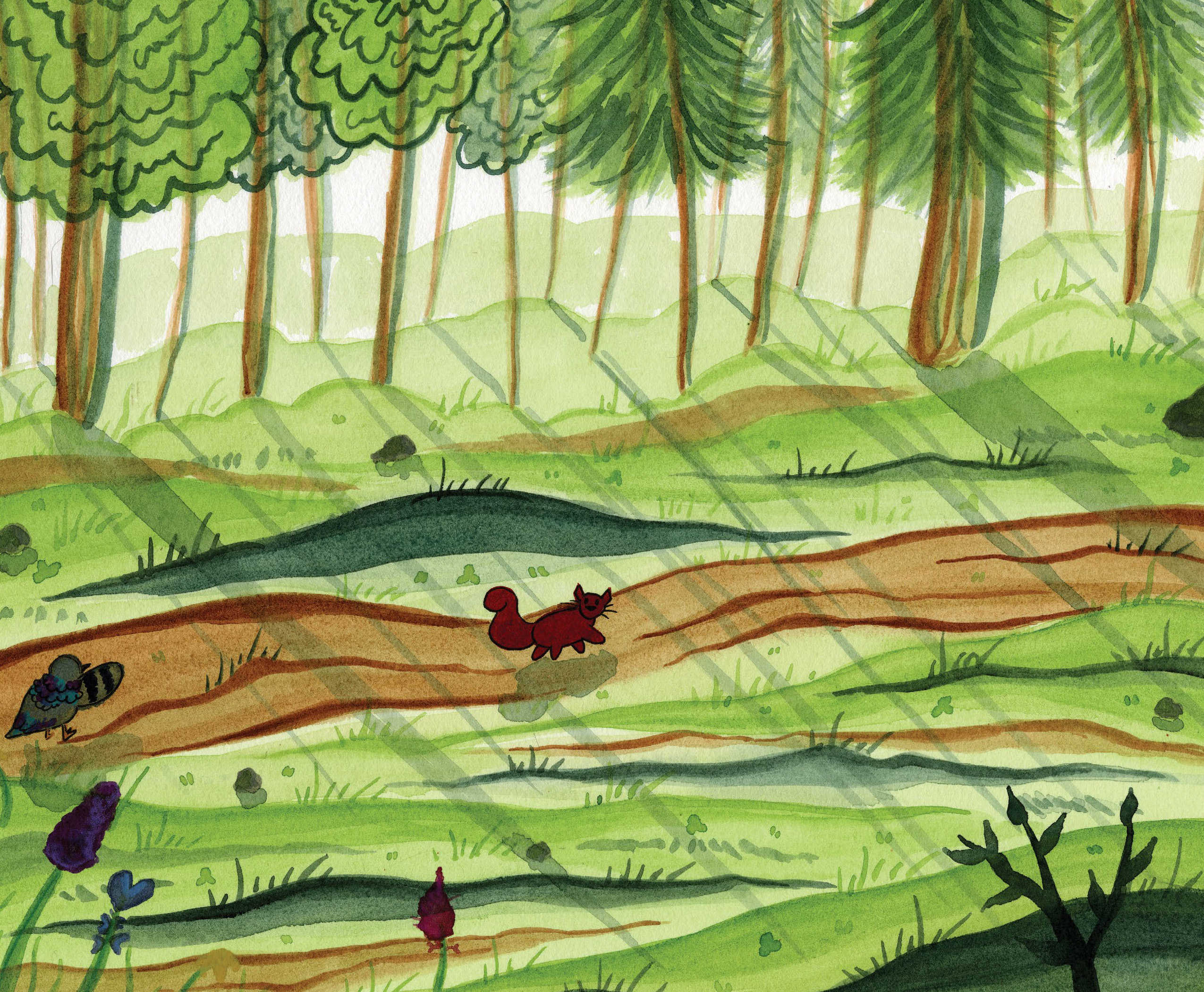
Skitter and Pogo hugged and promised to write more letters, then Skitter set off on his journey back home.
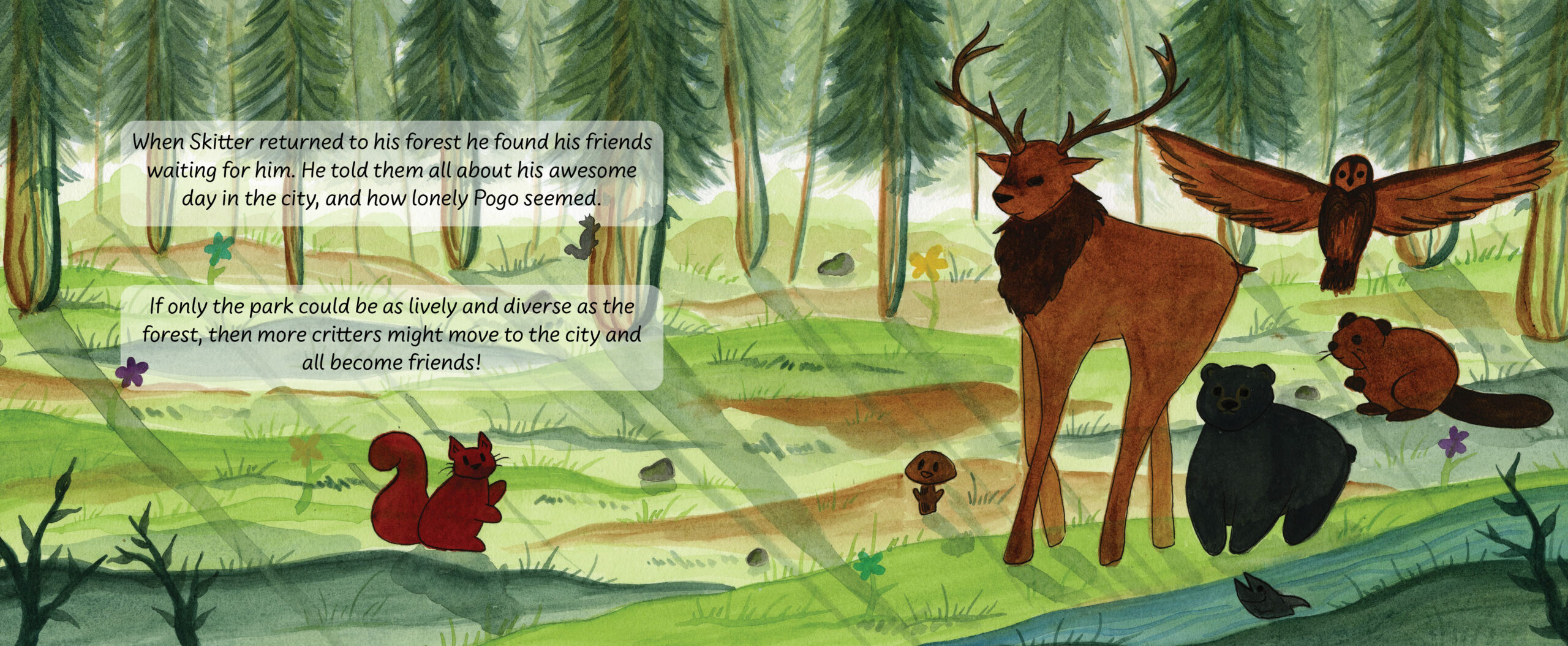
When Skitter returned to his forest he found his friends waiting for him. He told them all about his awesome day in the city, and how lonely Pogo seemed.
If only the park could be as lively and diverse as the forest, then more critters might move to the city and all become friends.
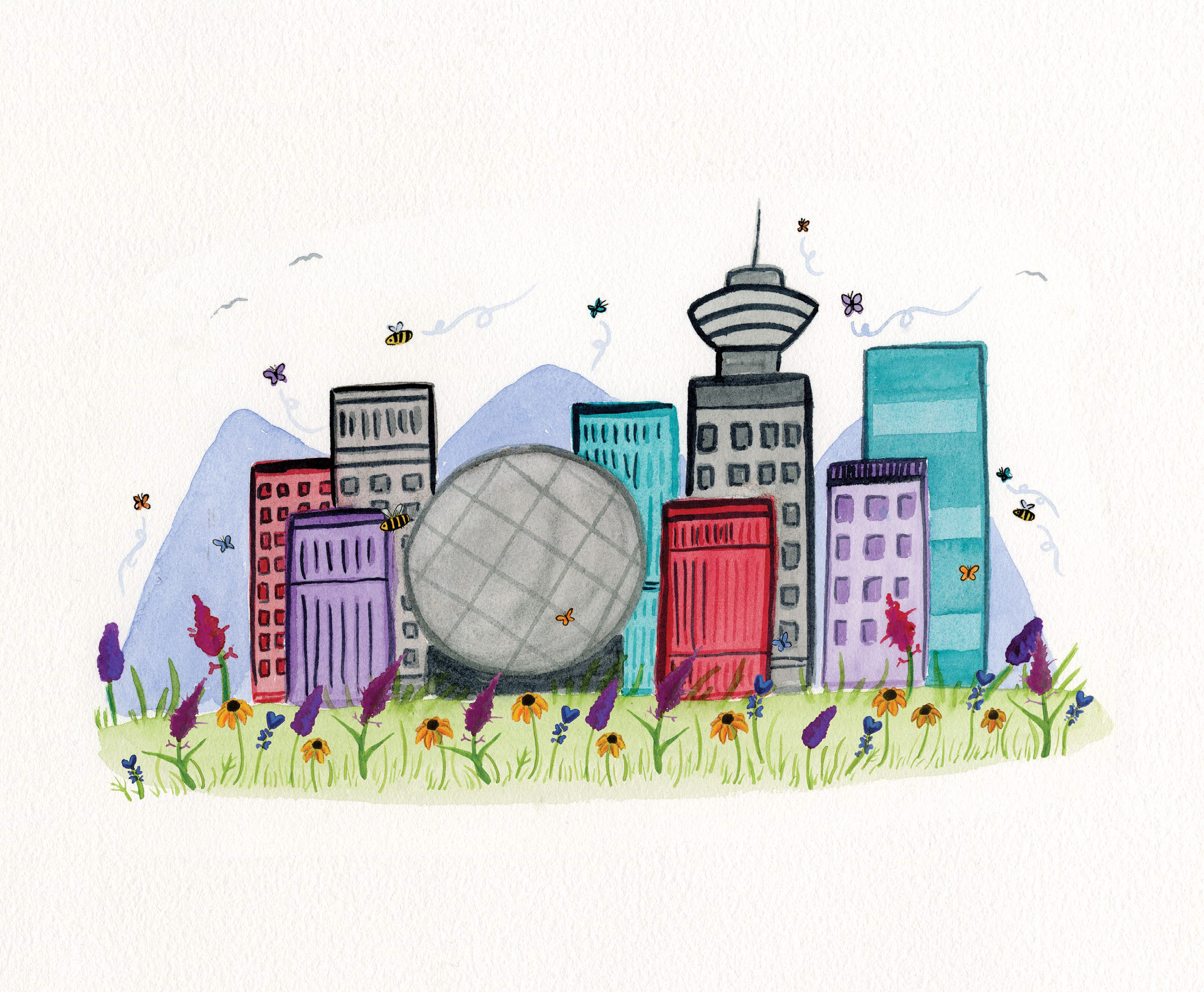
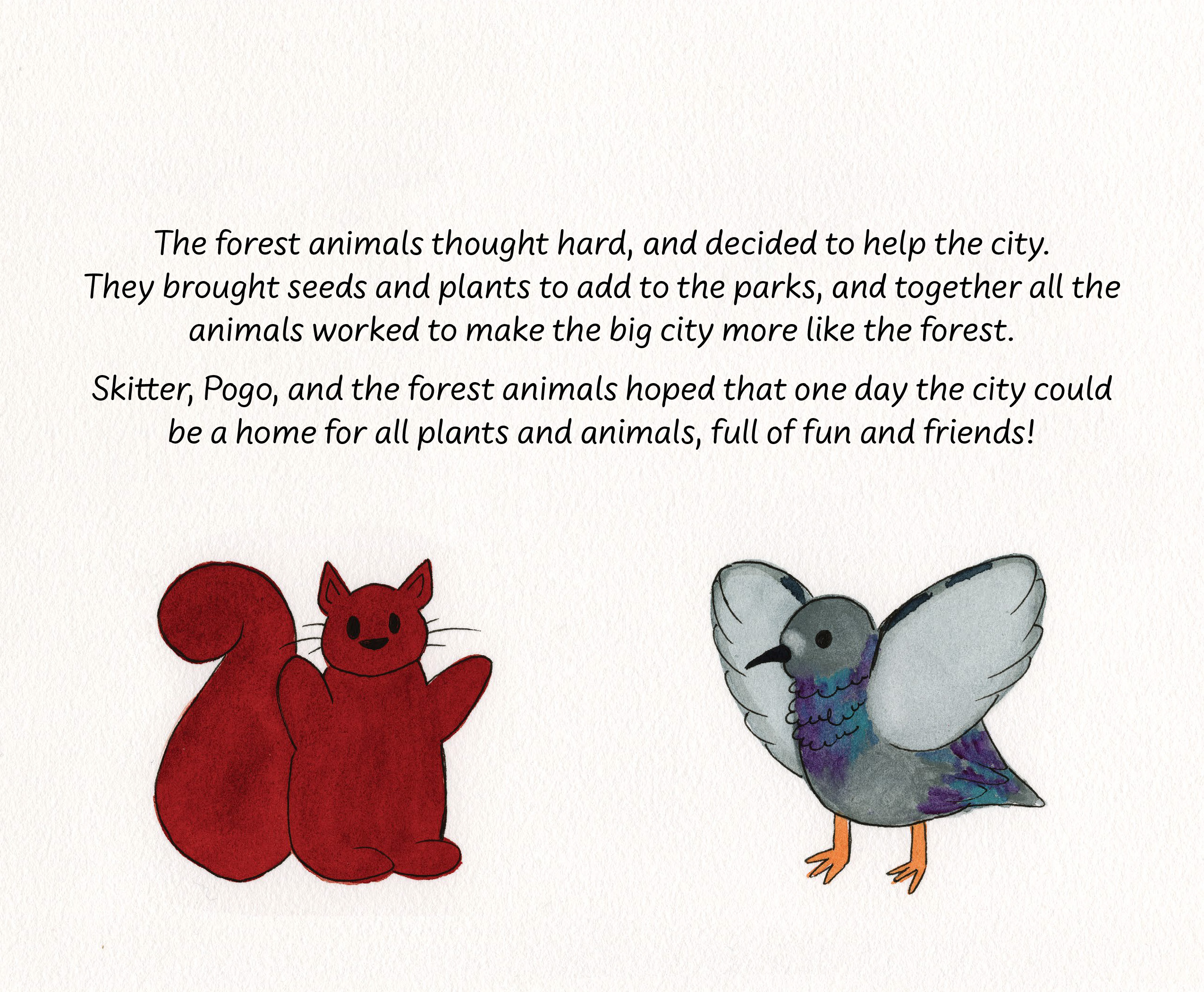
The forest animals thought hard, and decided to help the city. They brought seeds and plants to add to the parks, and together all the animals worked to make the big city more like the forest.
Skitter, Pogo, and the forest animals hoped that one day the city could be a home for all plants and animals, full of fun and friends!
Learn More
Skitter and Pogo’s fun day together is full of information about the Lower Mainland and the environment, and features an information page at the end of the book to help readers learn more. Here is some of the info that is included:
Skitter is based on the American Red Squirrel (Tamiasciurus hudsonicus). Red Squirrels are native to B.C’s coniferous forests and are found almost all over the province. Although many squirrels are found in cities and nearby environments, Red Squirrels tend to stick to their forests and are less likely to encounter cities and humans altogether.
Pogo is based on the Rock Pigeon (Columba livia). Rock Pigeons are not native to B.C but are commonly found in urban areas, such as Greater Vancouver. Although Rock Pigeons are technically an invasive species, they are well known and usually have a minimal negative effect on native bird populations due to their preference for city areas.
The flowers that Skitter and Pogo plant at the park are based on native wildflowers in the Lower Mainland ecoregion. These wildflowers are adapted to our local climate and require less care once grown. They provide nectar and pollen for pollinators such as butterflies and wild bees. The wildflowers depicted in this story are:
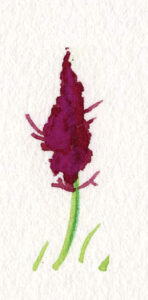
Fireweed
(Chamaenerion Angustifoliu)
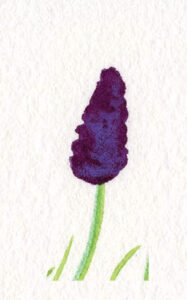
Silky Phacelia
(Phacelia Sericea)
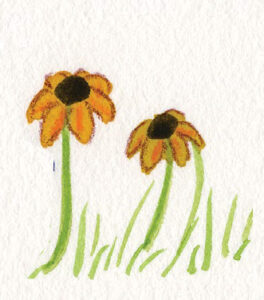
Blackeyed Susan
(Rudbeckia Hirta)
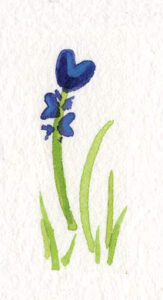
Miniature Lupine
(Lupinus Bicolor)
Supporting our local ecosystem can be both fun and educational. The easiest way for readers to help is remembering to Reduce, Reuse, and Recycle. Children are encouraged to talk to parents or teachers about planting native wildflowers on a patio, yard, or community garden. By growing native plants and avoiding synthetic fertilizers and pesticides, we can help create a safe space for pollinators. These are the first and easiest steps to helping the environment from home.
More information about growing native plants at home and supporting pollinators can be found on the David Suzuki Foundation website about the Butterflyway Project, which helped inspire my book.
Installation
The 40 page 7″ x 8.5″ book is on display on campus in front of the library.
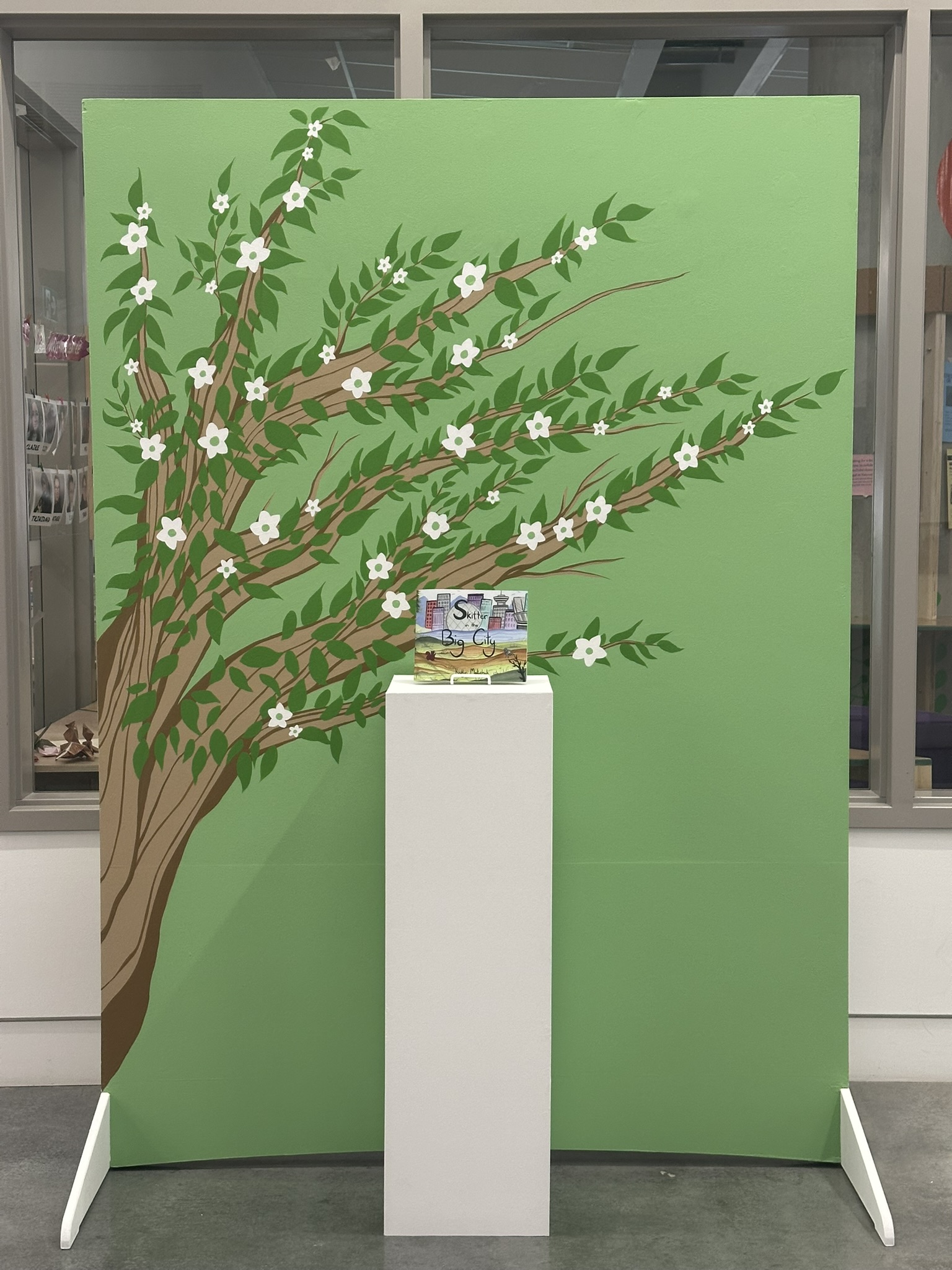
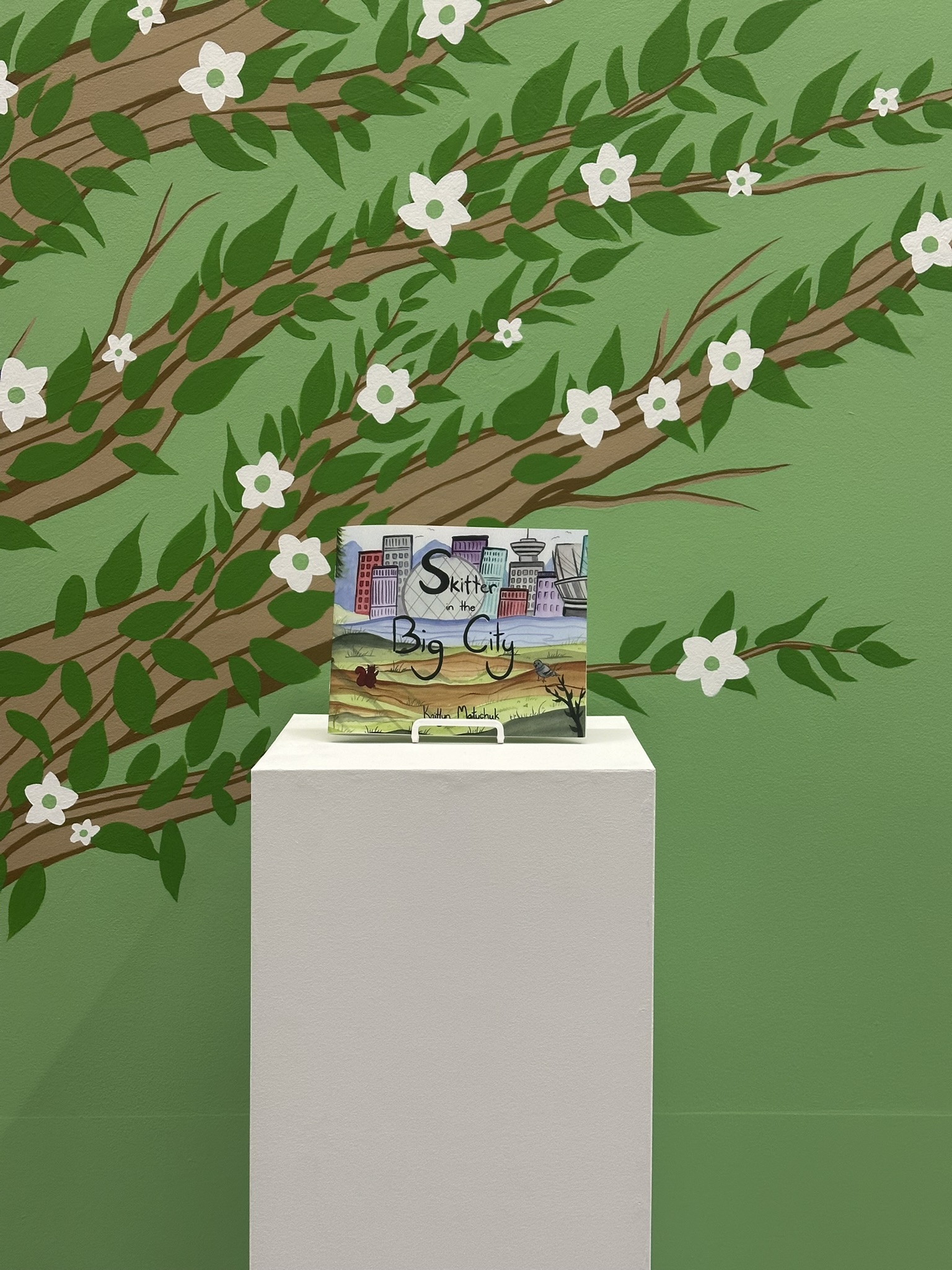
The background wall for the final installation depicts a Pacific Dogwood (Cornus nuttallii). They are native to the Pacific Northwest and are the official emblem of British Columbia.
Other Works
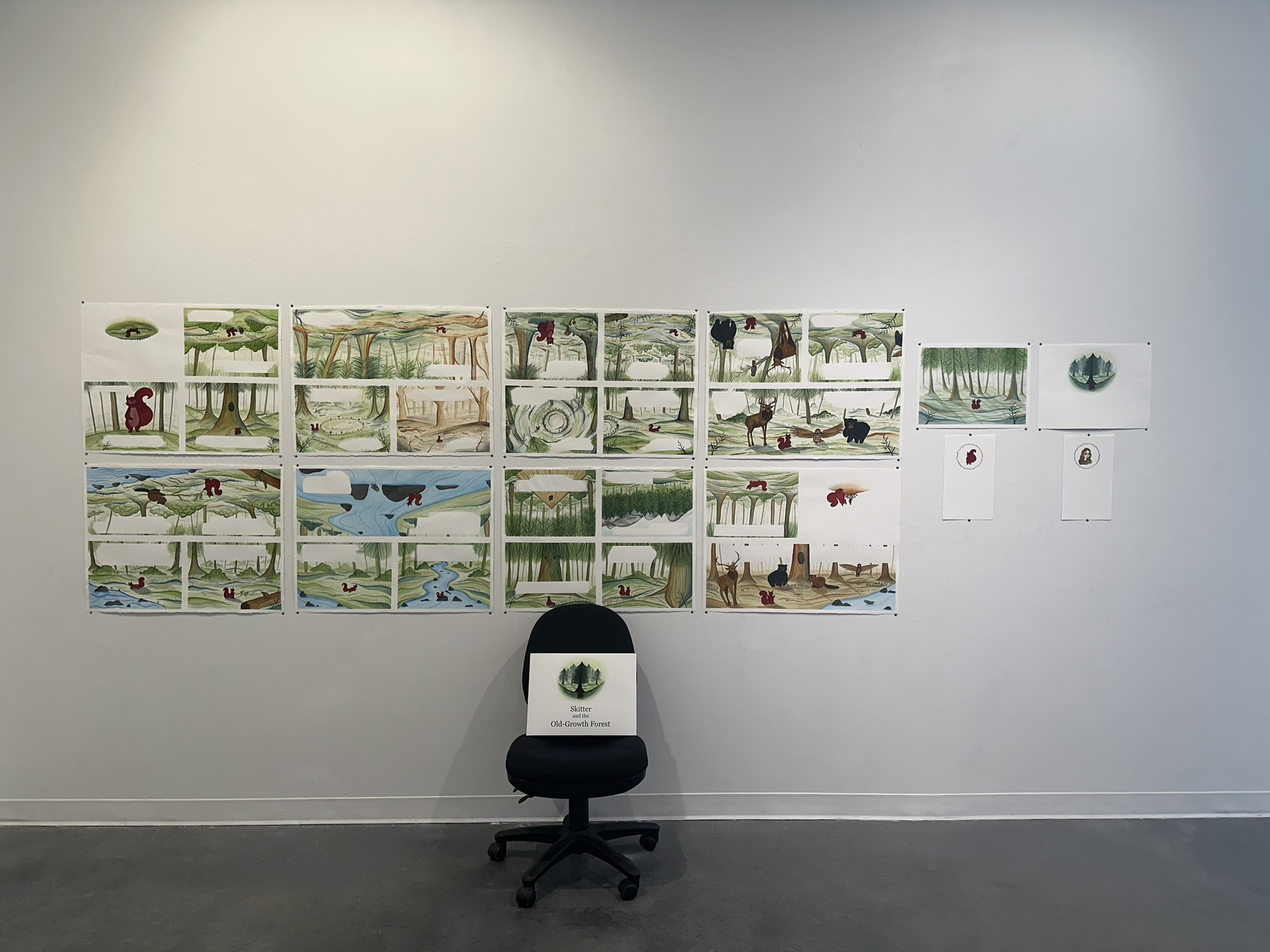
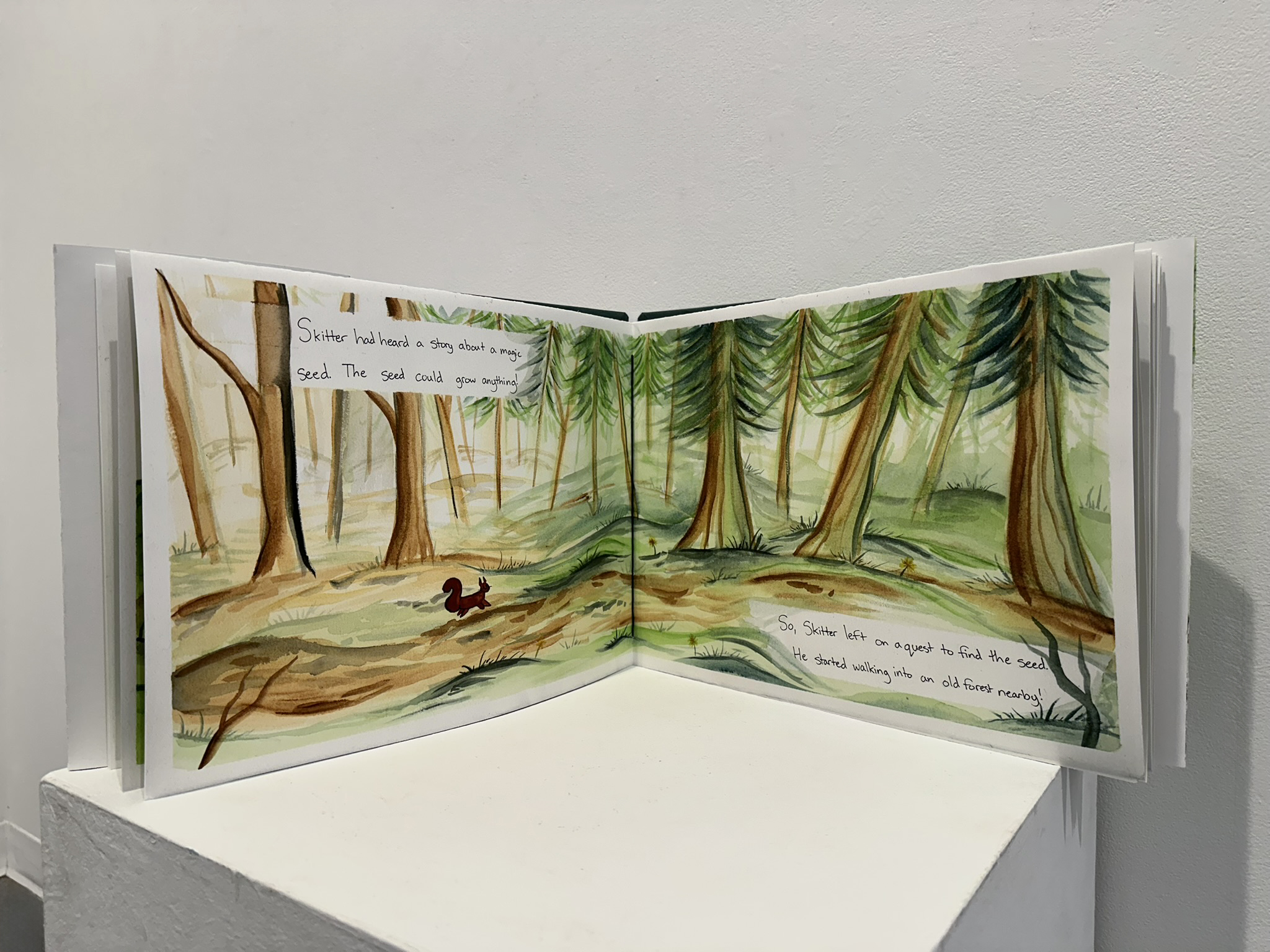
Skitter in the Old-Growth Forest, 2025
Coptic bound book created using watercolour illustrations, 11.5 x 15.5 inches
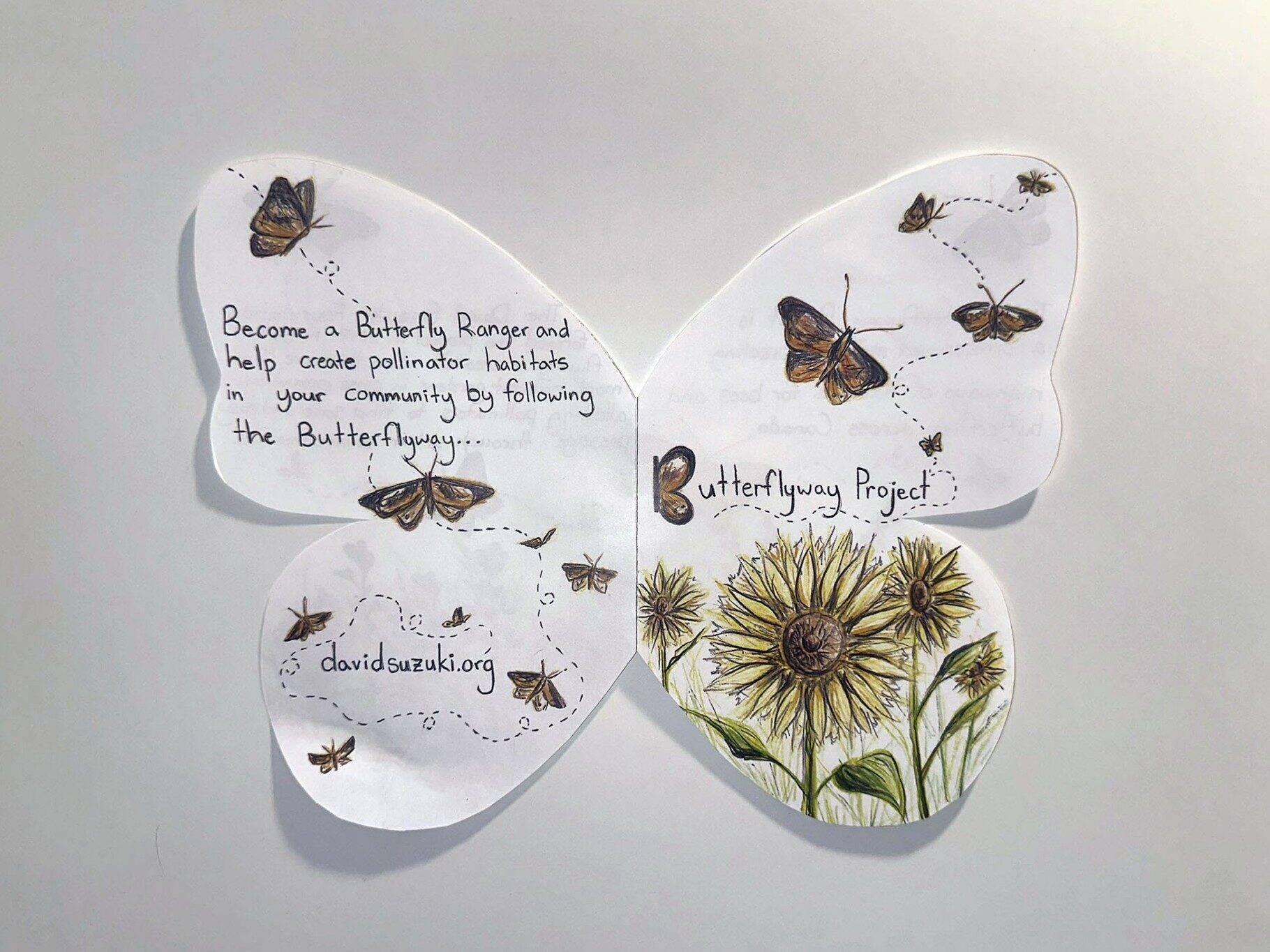
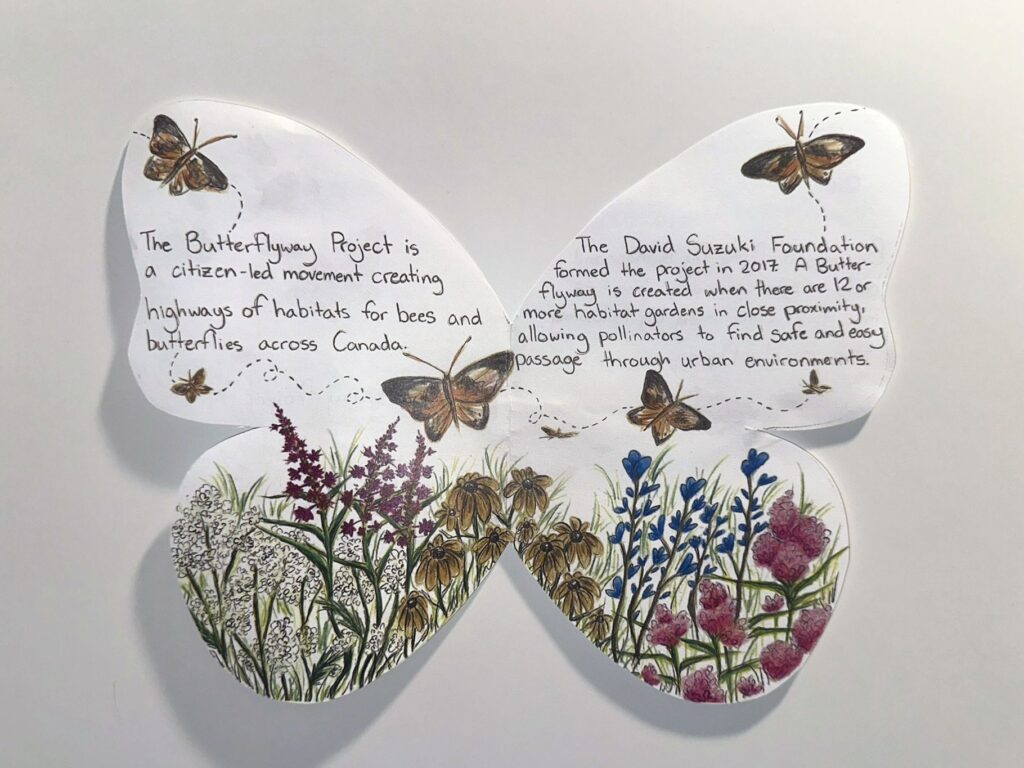
Butterflyway Project Pamphlet, 2026
Coloured pencils, graphite, printer paper, 8 x 10 inches