Down the Rabbit Hole: Digital Pathways to Extremism
Mia Jun Portelance
Abstract
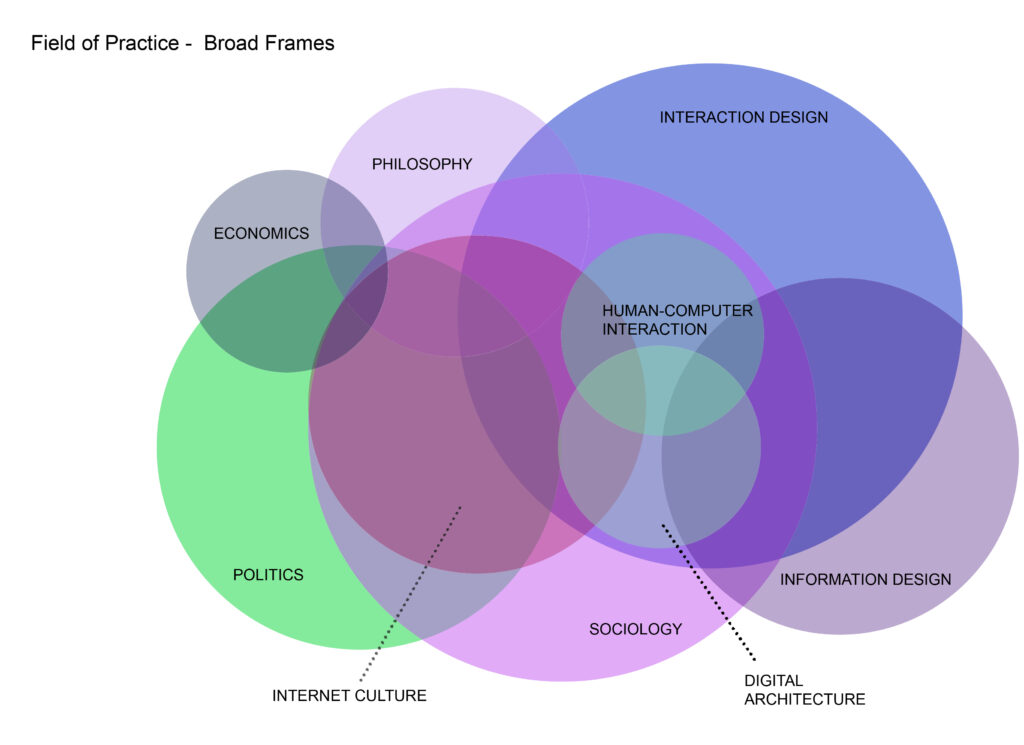
Down the Rabbit Hole: Digital Pathways to Extremism is a series of design explorations investigating some of the darker aspects of our digital spaces and online lives. Recent years have seen a troubling rise in polarization, echo-chambers, online hate and misogyny, alt-right pipelines, and many other forms of algorithmic distortion and disinformation. These darker paths, characteristic of online radicalization, show up in how we share and access information, the algorithms that circulate these dialogues, and the structures that own and govern the institutions and flow of data behind it. Existing between technological utopianism and deep misanthropy, this thesis seeks to explore these patterns and the implications of digital extremism in internet culture, and what role design might play as a means to better understand the current political and technological climate we find ourselves entangled in and build critical literacies to help navigate them. Through design experiments and reflection, Down the Rabbit Hole looks at the fears, tensions, and unknowns faced by designers and the public, and seeks ways surface issues, engage publics in conversation with them, and build critical questions to help us navigate the complexity we find in our online lives. The research looks at the social, political, and technological influences that cultivate conditions for digital extremism, and asks what roles design can play in surfacing, critiquing, and navigating these digital pathways?
Mapping Down the Rabbit Hole: Digital Pathways to Extremism
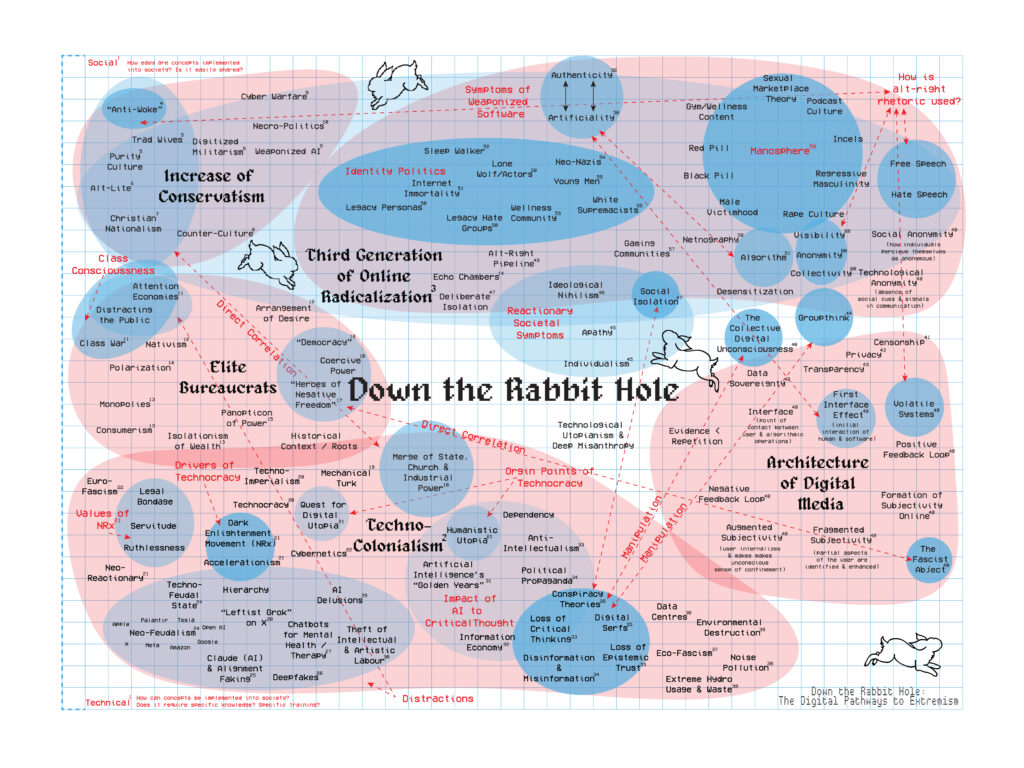
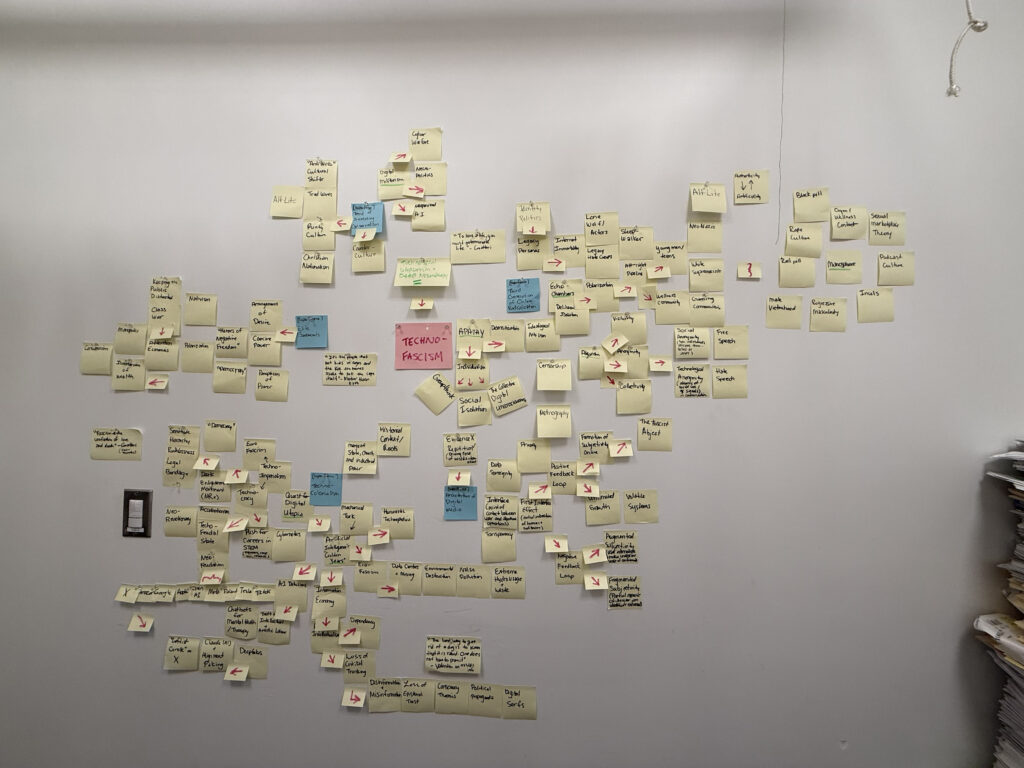
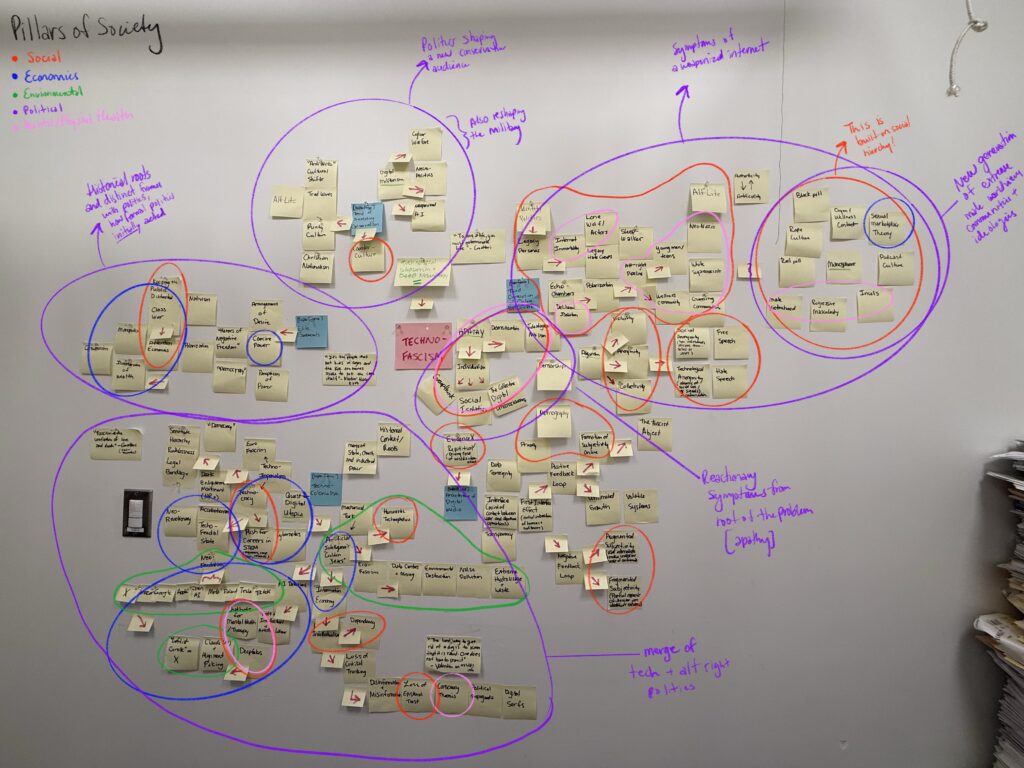
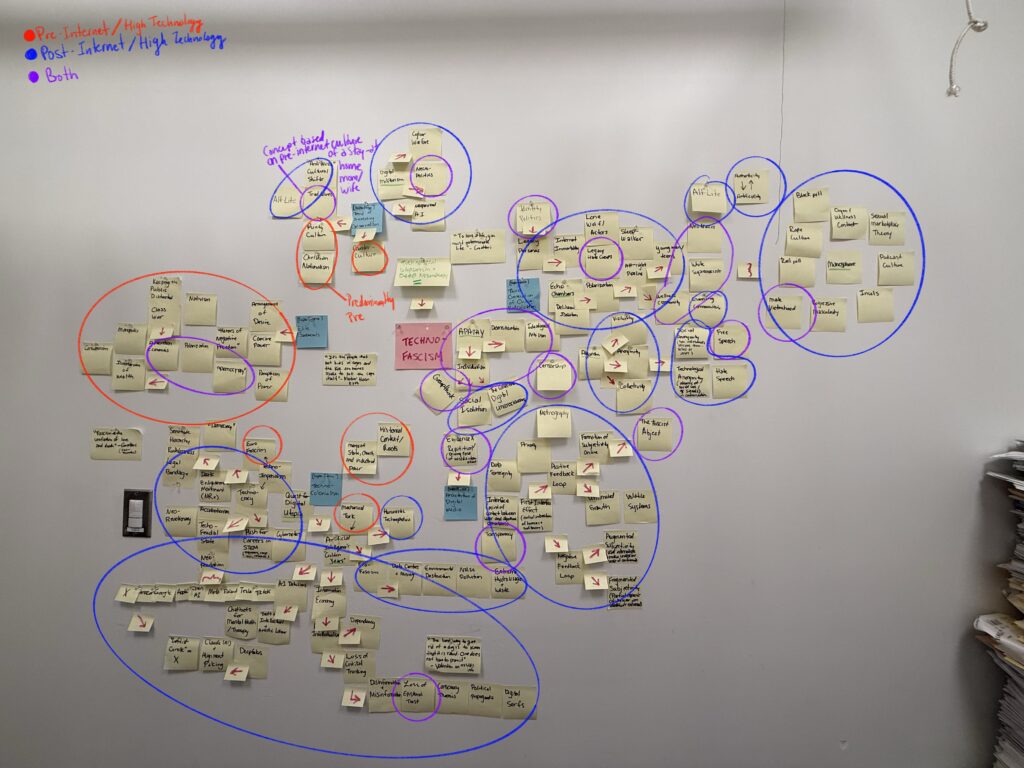
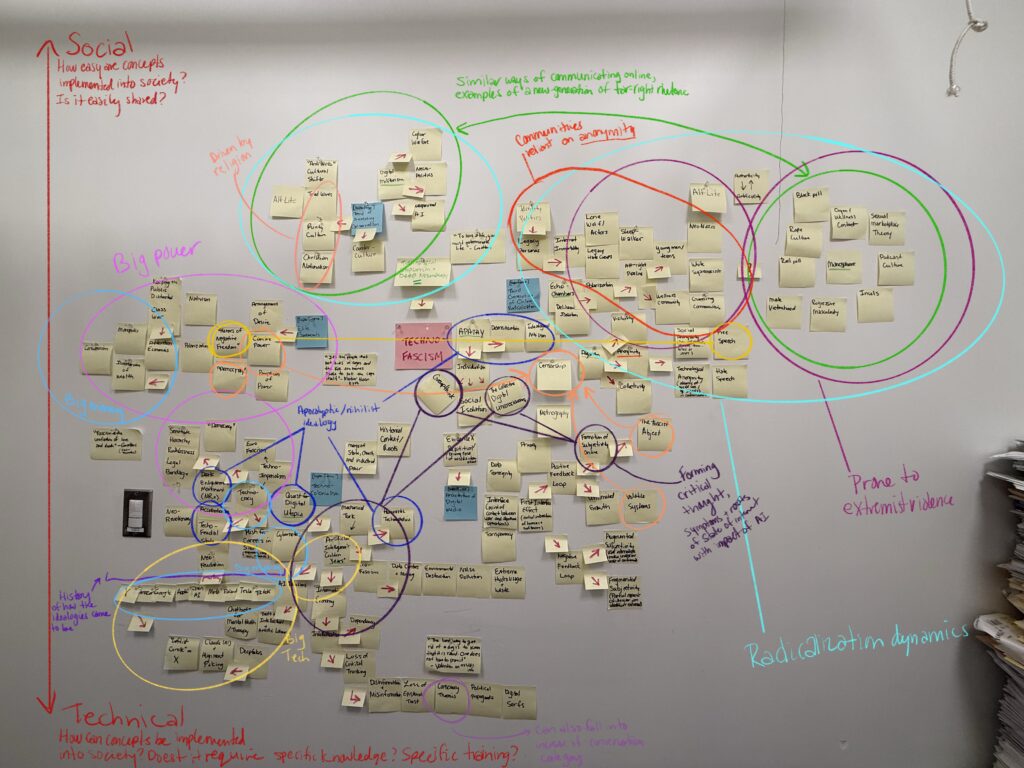
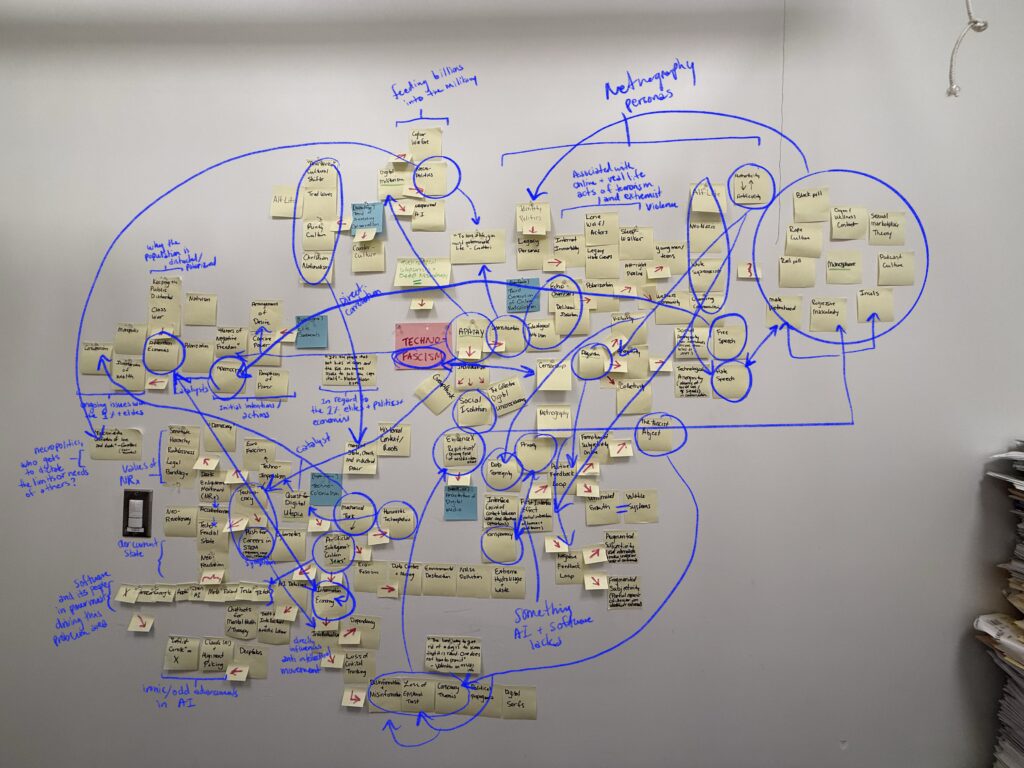
Mapping Down the Rabbit Hole: The Digital Pathways to Extremism is a research artifact dedicated to mapping a large swath of material and ideas that emerged through the research gathered over the course of this master’s thesis. It is an interactive mapping poster and companion website that synthesizes the information around five emerging super frames.
This map functions in tandem with the interactive website (see here) as a design artifact, surfacing what I discovered during the research process. Cultural movements, political periods, important figures and institutions, and fragments of the internet are uncovered through many layers and connections seen unfolded within the map. Links begin to emerge using this exploratory process, as they begin to be configured through an open-ended interpretation.


Techno Tarot
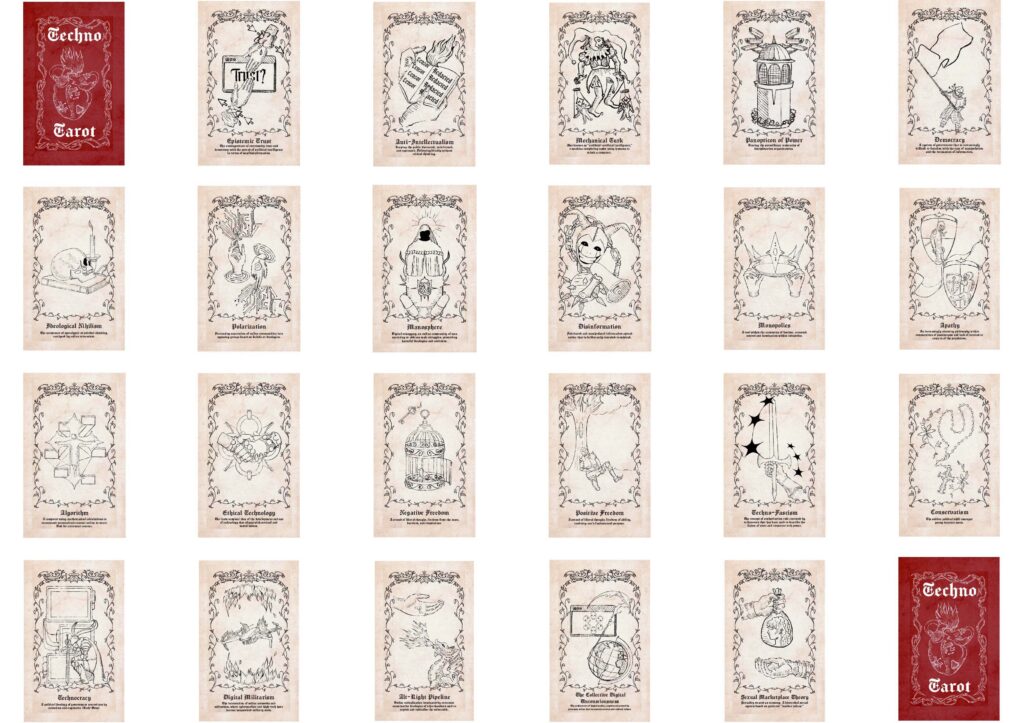
“Techno Tarot” uses the divination practice of tarot card readings to unpack the shared experiences that people are facing with the radicalization of technology. A series of 22 different tarot cards were designed, intersecting the esotericism of a traditional tarot card deck with contemporary themes of the digital world. The illustrations merge the idea of old and new, combining medieval art movements (Romanesque art, Gothic art,) from illuminated manuscripts, cathedral architecture, and paintings, with modern technological concepts (gothic architecture, manuscripts, painting/manuscripts with a technological context.) The cards provide participants with a glossary of important keywords in relation to Down the Rabbit Hole: The Digital Pathways to Extremism, accompanied by concise definitions that corresponds and communicates the design. By using the mysticism of tarot cards, “Techno Tarot,” gives participants a sense of the future of the internet, navigating the unseen forces guiding one’s digital destiny and role within online spaces and communities. As a tarot reading occurs, participants view how the mechanics of the practice develops a narrative when connecting the individually selected cards, communicating a prediction involving the future state of digital spaces, dialogues on the socio-political and cultural context of technology, and the relations of who and what governs technological advances. The formation of subjectivity occurs between the oracle and participant, offering guidance and reflections to navigate the technological sphere.
Promise You’ll Listen?
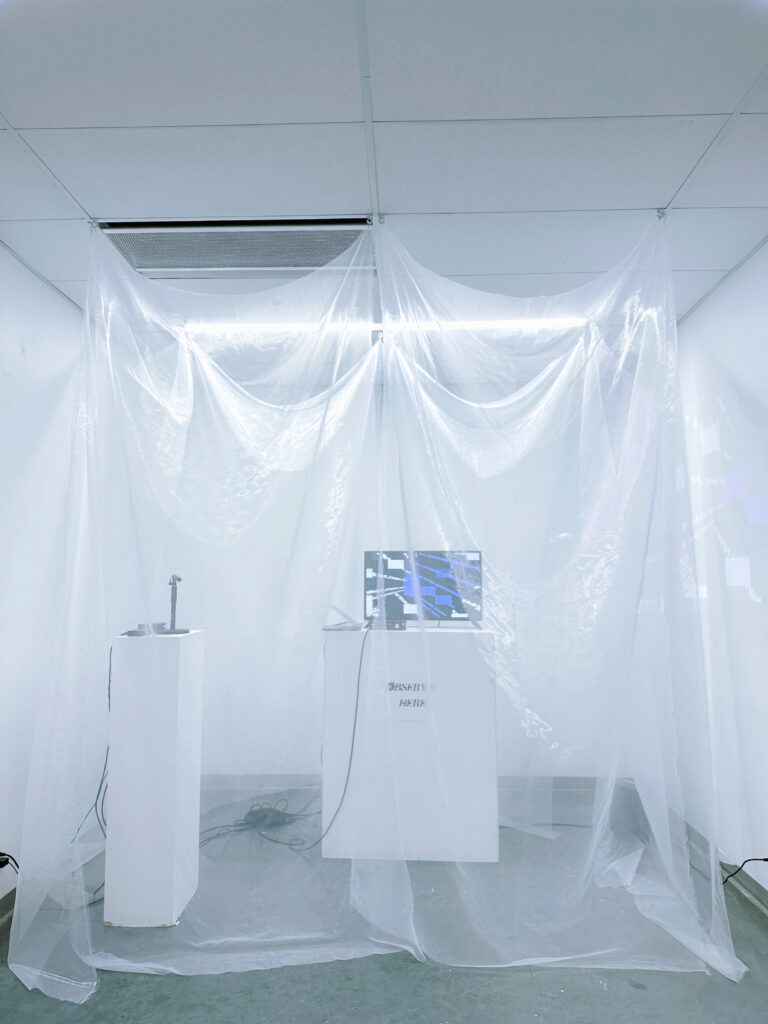
Promise You’ll Listen? explores the intersection of new media and installation design through a physical alt-right echo chamber manifestation. The installation allows viewers to engage in an audio-visual experience surrounding data extracted from online propaganda and disinformation inspired by the study Echo Chambers, Rabbit Holes, and Algorithmic Bias: How YouTube Recommends Content to Real Users by Megan A. Brown et. Al.
Promise You’ll Listen? engages viewers to question their relationship with the internet and the algorithm that builds these environments. It intends to blur the lines between reality and simulation through a physical manifestation, through the exploration of the intersection of new media and physical installation. As viewers navigate into the installation, they will be immersed in a boxed-off space, separated by a curtain of organza where the audio-visual aspect is conducted. The data visualization developed with Touch Designer is seen projected on a screen. The red text represents conservative-coded keywords, and the blue text represents liberal-coded keywords and as the animation progresses, the text converges into a grey area representing the space of neutral users and content. The echo chamber space is amplified through the visual components and repetition seen, it is projected both on a screen and as a large wall space using a projector, immersing the viewers. The animation warps, distorts and converges together, contributing to the audio-visual experience and blurring the lines of being inside a physical manifestation, while observing the explicit terms derived from online versions of the echo chambers. As participants continue to experience the exhibition, they will notice any sounds and voices being echoed through an audio system. Apart from a physical manifestation of an echo chamber, this is a direct reference to how echo chambers become distorted manipulated, as the audio becomes louder, and inaudible. This feature was created using the audio software Reaper, a mic, mixer, and a speaker.
Cyberfeminism, Next Protocols
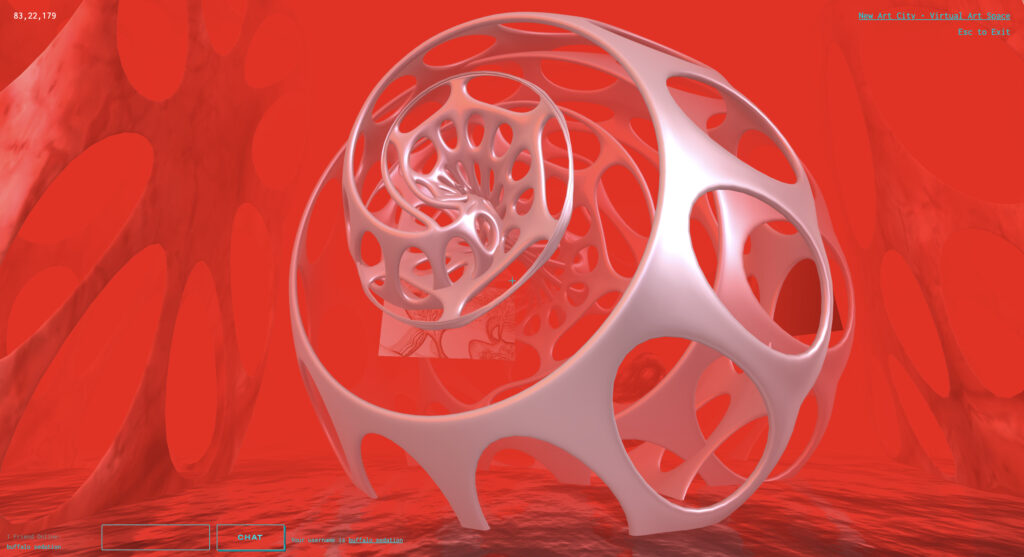
The concept of re-fleshing the body is explored through an immersive online space using Yvonne Volkart’s 2004, “The Cyberfeminist Fantasy of the Pleasure of the Cyborg.” Volkart explores the concept of cyberfeminism, illustrating the fusion of technology and the human body. She reasons that the cyborg, a hybrid of the human body and machine body, challenges traditional notions of identity, gender, and power. New technologies are observed through the belief that they shape modern society, economy, bodies, gender, identity, and subjectivity. Therefore, Volkart provokes thoughts of bodies in online spaces, and how technology affects self-expression and connection in a digital age, catalyzing the project, “Cyberfeminism, Next Protocols.” The web AR space was created to encapsulate using the example of “cyborg” to redefine the weight and cost of having a female body during the age of the internet, within online spaces. Using the framework for a “cyborg,” conventional notions of self and sexuality are explored through a hybrid existence of both organic and biomechatronic materials within this space, appearing through heartbeats, blood pumping, womb imagery, and cyborg adjacent bones. “Cyberfeminism, Next Protocols” embraces a hybrid existence that can lead to new forms of empowerment and freedom, suggesting the cyborg is an endless site of reimagining what an identity can appear like, online. The immersive space integrates these ideas into practical and theoretical frameworks to push the boundaries of conventional identities and experiences. View here.