MedMatch — Medication Safety Tool for International Students in Canada
Amy Ma
A medication safety tool that helps international students in Canada safely check whether their home medications can cross the border, and find verified Canadian equivalents — preventing medication errors and supporting confident self-care.
Problem Space
According to a study by the University of Toronto, international students are “confused about how to obtain medications” and twice as likely to face difficulties accessing healthcare. They avoid doctor visits due to uncertain costs, language barriers, and confusion with the system — so they self-treat.
They take medications brought from home alongside Canadian OTC options without realizing both contain the same active ingredient, leading to dangerous overdoses. Many also unknowingly bring controlled or restricted medications from home, risking customs violations and fines.
Design Question
How might we help international students safely find Canadian equivalents for their home medications, so that they can manage their health confidently without medication errors?
Solution
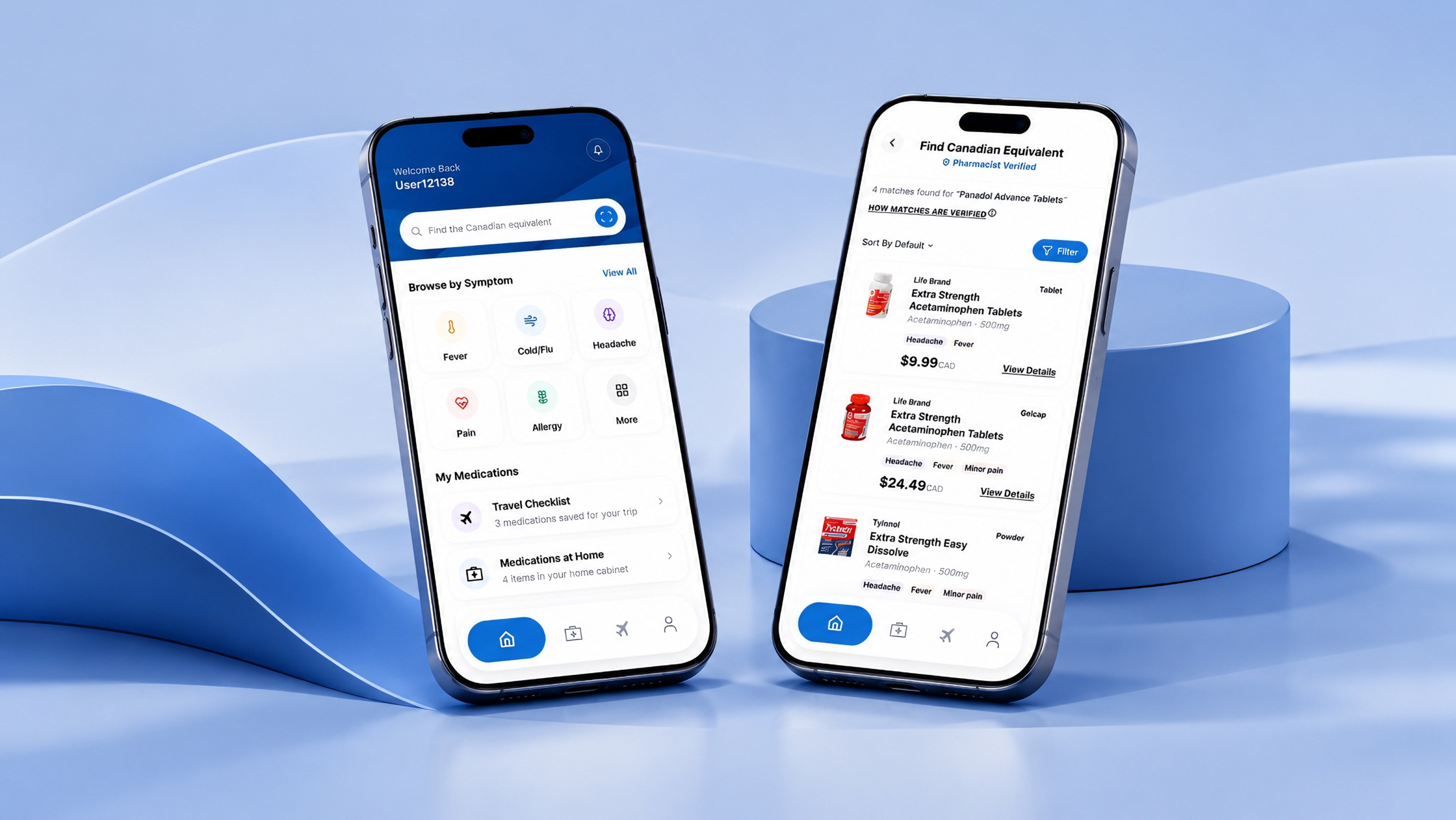
MedMatch is a medication finder app designed to prevent medication errors among international students by helping them find safe Canadian equivalents for medicines from their home country, check if medications are legal to bring across the Canadian border before they fly, and track their medications safely at home.
Personalized Onboarding
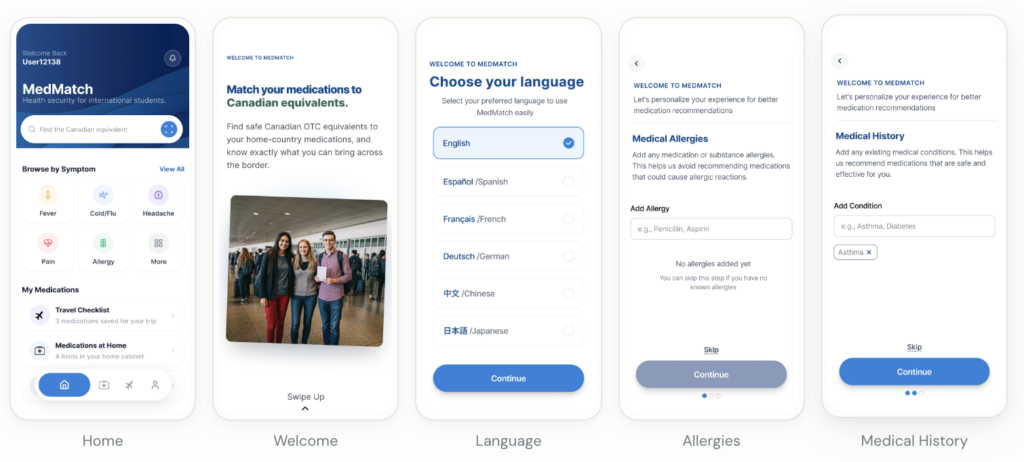
A 3-step onboarding collects preferred language, allergies, and pre-existing conditions. This filters all medication recommendations to exclude contraindicated products — replacing the dangerous practice of acting on a friend’s recommendation.
01 Travel Check
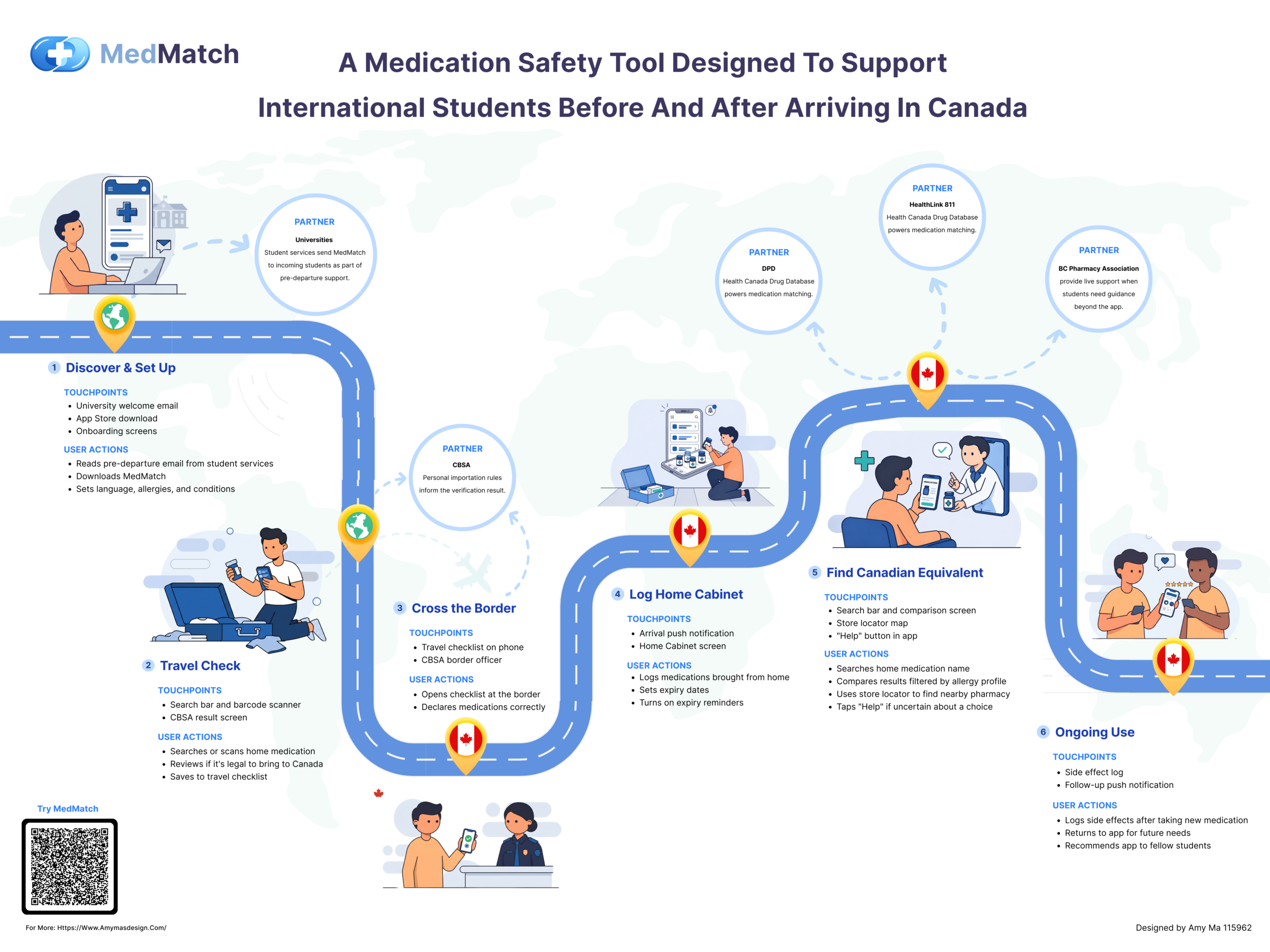
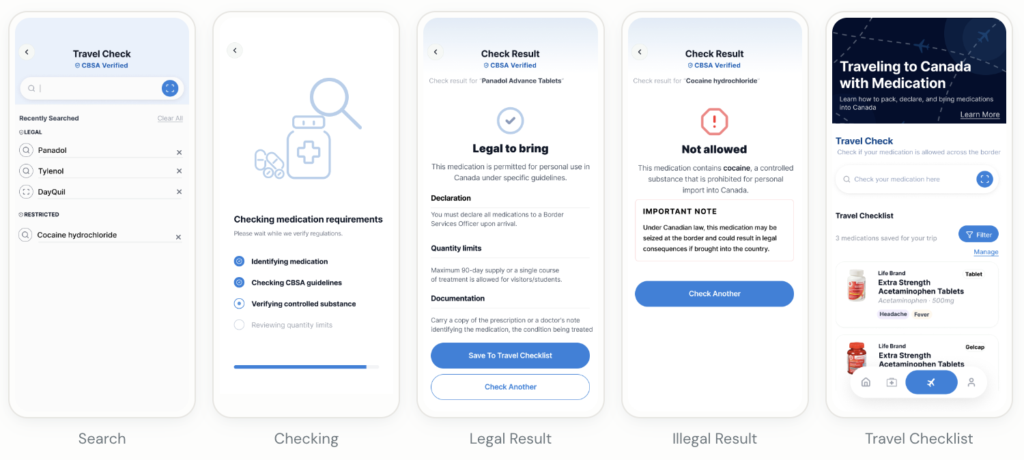
Before flying to Canada, students search any medication by name to instantly see CBSA legality status, quantity limits, and required documentation. Legal medications can be saved to a Travel Checklist for easy border declaration. Powered by Health Canada and CBSA Personal Importation Policy.
02 Equivalency Finder
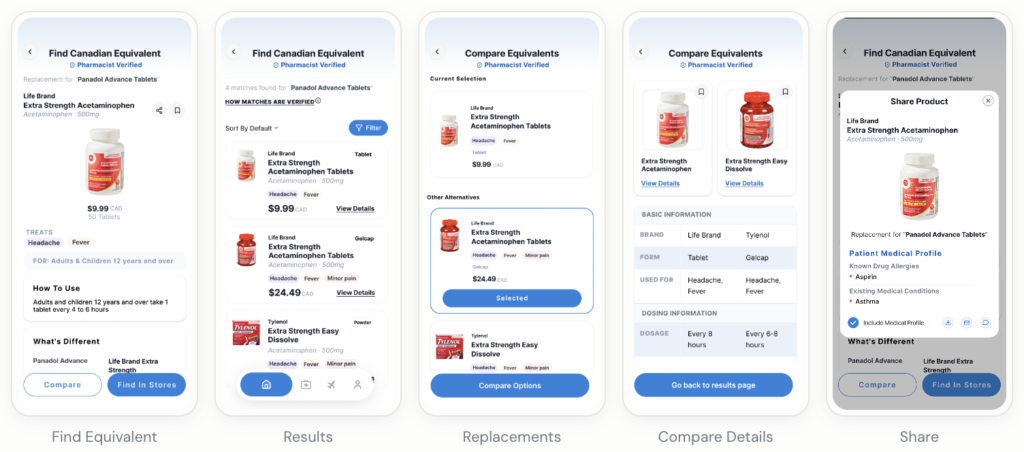
Once in Canada, students search their home medication by name or scan its barcode. MedMatch matches on identical active ingredient and strength, verified against Health Canada DPD. Results show price, form, and stores. If no match exists, the app explains why and redirects to HealthLink BC.
03 Home Cabinet
A personal medication tracker that stores medications at home with expiry dates, dosage, side effects, and symptoms treated. Expiry alerts prompt safe disposal. A filter prevents adding medications with duplicate active ingredients — an active safety guardrail from pharmacist consultation.
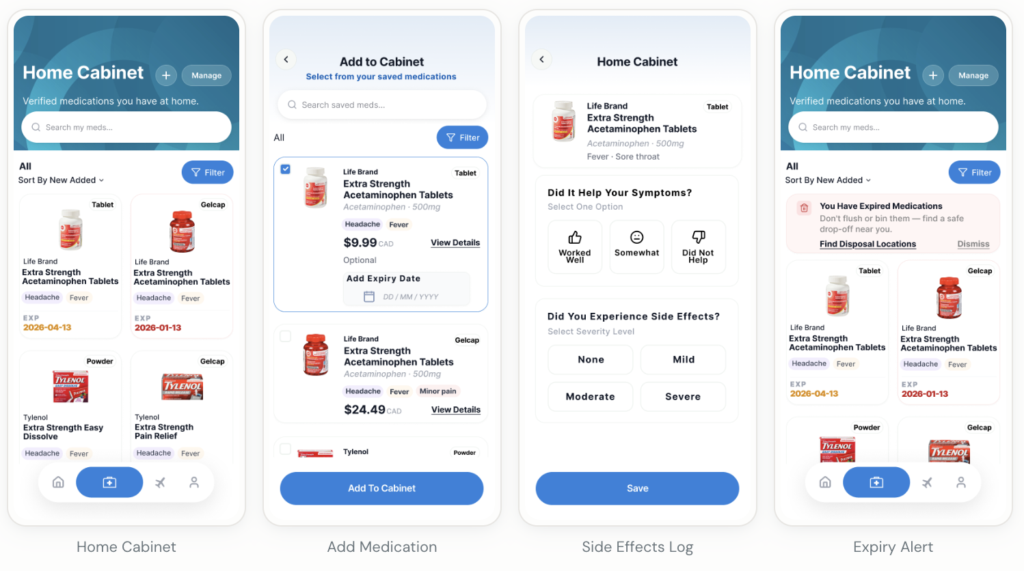
04 Safety Guidance & Edge States
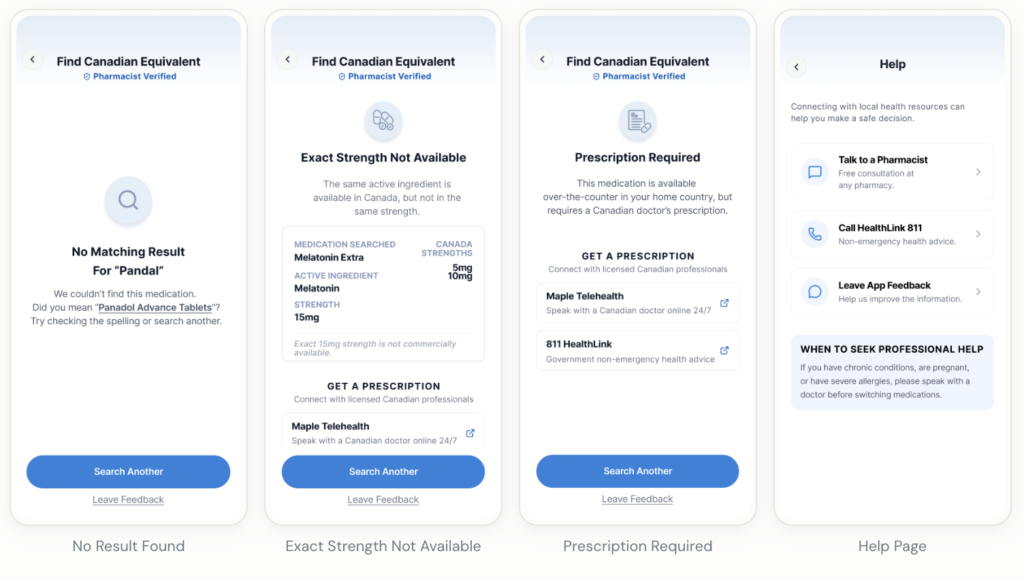
When a search can’t return a safe result, MedMatch never leaves the user stranded. Unrecognized medication names surface a spelling suggestion. Strength mismatches show what’s available in Canada and route to Maple Telehealth. Prescription-only medications are flagged immediately. The Help page — reachable from anywhere — offers a free pharmacist consultation and guidance on when to seek professional care.
Try MedMatch
Partners
The following organizations represent the institutional partners that would need to be engaged to deploy MedMatch at scale — providing accurate drug data, clinical validation, and student reach.

Health Canada / CBSA
Official drug monographs, DIN numbers, active ingredient data, and controlled substance schedules for the Travel Check feature.

BC Pharmacy Association
Content review partnership for ongoing medical accuracy validation of equivalency matching logic.

HealthLink BC (811)
Referral link when no match is found or professional guidance is needed. Non-emergency health advice line.

Universities
Distribution channel — recommended in student handbooks and pre-arrival emails to reach students before they land.
Process
10
International students interviewed (2 rounds)
2
Pharmacists consulted
3+
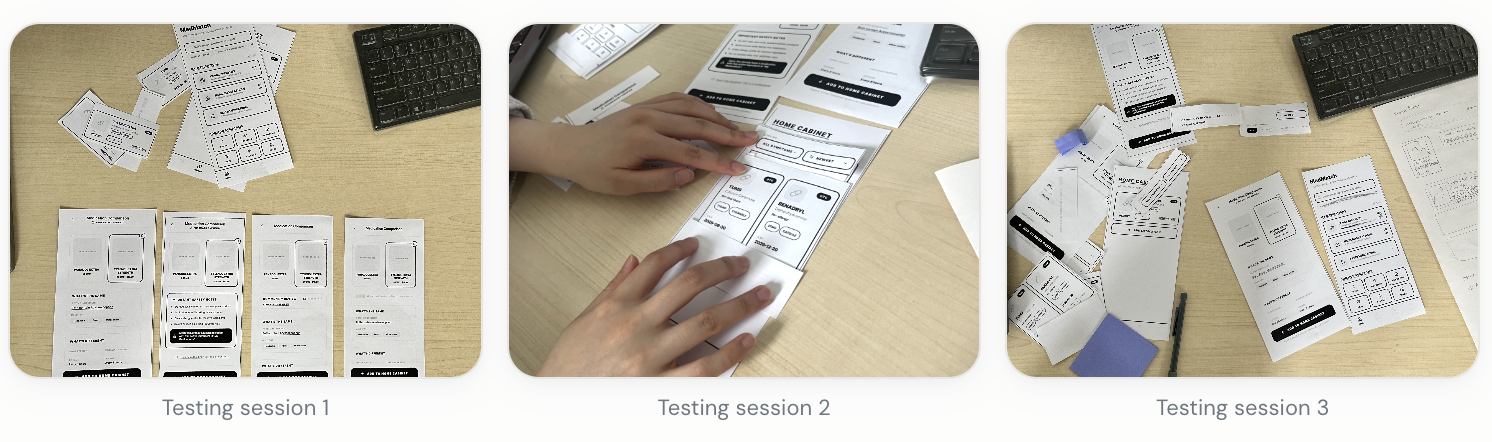
Rounds of prototype testing
Understanding the User
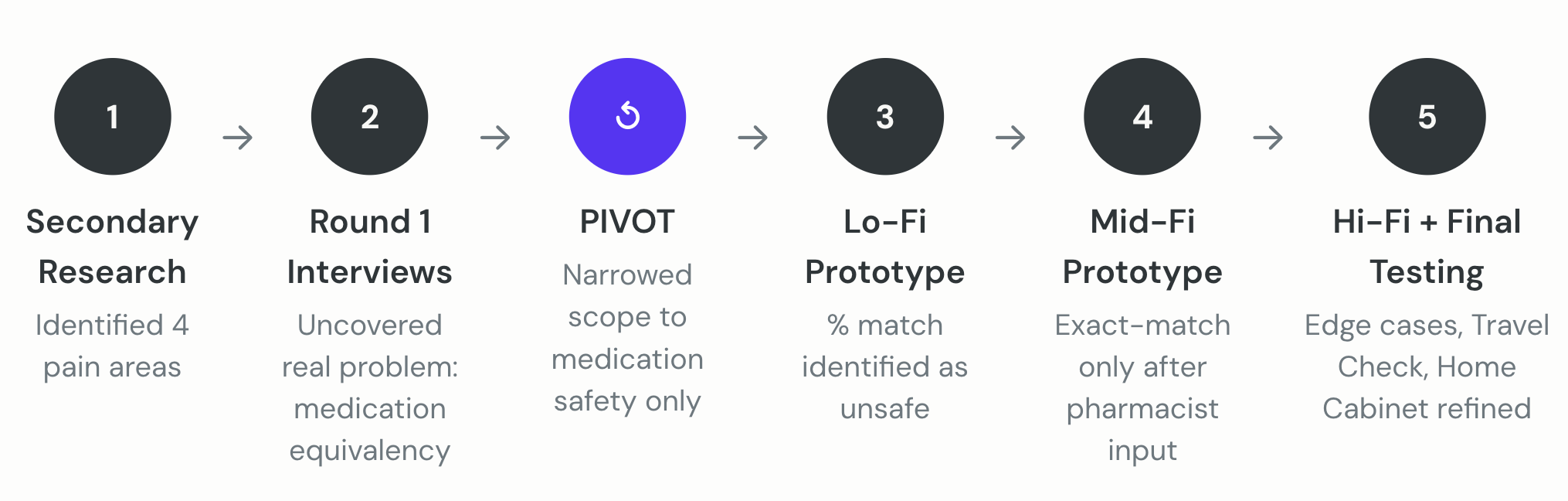
Research began with secondary sources — Statistics Canada data, pharmacy literature, and competitor analysis. A recruitment survey was initially planned but after three early interviews revealed a fundamentally different problem, the survey topic was abandoned. Primary research focused entirely on medication safety behaviours.
- Secondary Research: Competitor analysis, medication safety literature, BC healthcare statistics.
- Round 1 Interviews: 5 international students (5 nationalities) — explored healthcare behaviours and medication habits.
- Pharmacist Interviews: 2 registered pharmacists — validated equivalency logic and safety requirements.
- Round 2 Interviews: 5 international students — usability testing on lo-fi and mid-fi prototypes
Key Insights From Research
Students Self-treat, Not Navigate
Most students avoid doctor visits due to cost uncertainty and long wait times. When unwell, they reach for medications brought from home — not the healthcare system.
Same Drug, Different Names
Medications with identical active ingredients carry different brand names across countries. Students had no reliable way to identify if a Canadian product was the same as what they had at home — raising real risk of unintentional double-dosing.
Border Anxiety
Students were uncertain about CBSA rules around bringing medications into Canada. They relied on conflicting online forum posts with no authoritative source.
No Verified Tool Exists
Existing apps focused on prescription management or general drug lookup — none addressed OTC medication equivalency across countries for a non-English-native audience.
From Broad to Sharp
The project began with a broad hypothesis: international students struggle to navigate the Canadian healthcare system. Early ideation produced a feature-heavy app. Three interviews changed everything.
Reflection
The design is the safety guardrail
Rather than informing users and trusting them to act safely, MedMatch limits the choices available — showing only exact matches, filtering by allergy profile, flagging illegal medications. Removing risky options is more effective than warning against them.
Consulting domain experts is non-negotiable in health design
Pharmacist consultations directly changed the product logic. Without them, the percentage match system — which seemed reasonable — would have shipped as actively dangerous. In healthcare, designer intuition must be checked against clinical expertise.
Unexpected pivots are evidence of good research
The medication equivalency problem was a minor item in the original feature list. It became the entire product because interviews surfaced real behaviour, not assumed behaviour. Staying open to pivoting mid-process is core design practice.
Designing for multicultural users means designing for uncertainty
International students arrive with different health literacy frameworks, different medication naming conventions, and varying English fluency. Every decision — label text, iconography, the ‘Pharmacist Verified’ badge — had to function under conditions of partial comprehension.